Showing posts with label Paintings. Show all posts

Monday, 27 February 2023

Khyber Pass and Jamrud


Khyber Pass and Jamrud. 19th century painting. Signed C R monogram.

Entrance to the Khyber Pass and Fort of Jamrud, 1878. A print from The Illustrated London News, (5 October 1878).


Khyber Pass from the Staff Camp, mid 20th century watercolor painting. Attrib. J.

Sunday, 26 June 2022

An 18th century portrait of Pashto poet Rahman Baba (Abdur Rahman Mohmand)

Hazrat Ilyas and Hazrat Khizr seated beside a pond with 'Abd al-Rahman Mohmand praying in the foreground. The image of His Holiness Elias and His Holiness Khidr and 'Abd al-Rahman praying..

From a richly illustrated manuscript of Pashto diwan of Rahman Baba, commissioned by Sardar Abdullah Khan Barakzai, Kashmir, dated to 14th October, 1798. Source


Wednesday, 22 June 2022

A late 16th century painting illustrating Sher Khan Sur's capture of Rohtasgarh fort through stratagem

Sher Khan Sur’s capture of Rohtasgarh fort in 1539 A.D. Ascribed to the artists La’l, Dhanu and Khem Karan, leaf from the ‘third’ Akbarnama, Mughal India, circa 1595-1600 A.D.
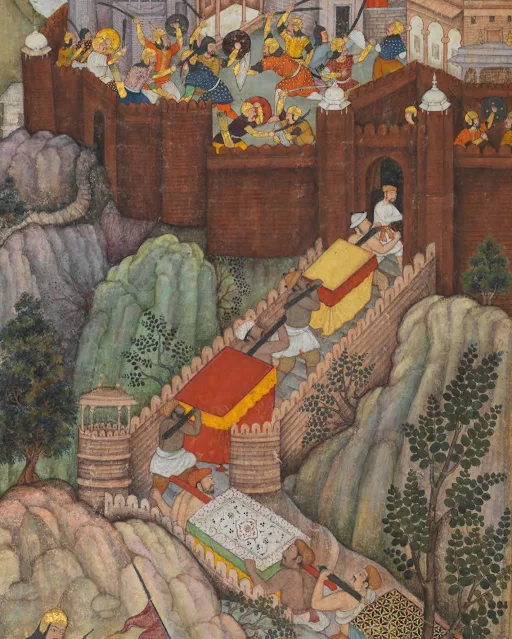
16th century painting depicting capture of Rohtasgarh fort by Sher Shah Suri

16th century painting depicting capture of Rohtasgarh fort by Sher Shah Suri


This skilfully designed painting illustrates part of the Sher Khan Afghan’s campaign against the Sultan of Bengal and against Humayun when he attempted to interfere. Sher Khan Sur was an Afghan born in India who carved out an empire for himself in Bihar and Bengal while Babur was busy expanding his empire from Agra and Delhi. In 1540 Sher Khan, or Sher Shah as he became, was able to drive Humayun out of India and assume the throne at Delhi. He was already the master of eastern India when Humayun marched against him in 1538. Humayun captured Gaur, the capital of Bengal, but Sher Khan had fled into the mountains of south Bihar with the treasure of Bengal and captured the great fortress of Rohtasgarh by the following stratagem:

From the Akbarnama (I, p. 335): 

"When Shēr Khān arrived in the neighbourhood of Rohtās, which is a very strong fort, he sent messengers to Rājā Cintāman, a brahman, the owner of the fort, reminding him of past favours, and after making a foundation of friendship, he represented to him that he was in a difficulty, and begged him to treat him with humanity and to receive his family and dependants into the fort, and thus make him (Shēr Khān) pledged to be his benefactor. By a hundred flatteries and deceptions the simple-minded Rājā was persuaded by the tricks of that juggler. He, a stranger to friendship’s realm, prepared six hundred litters, and placed in each two armed youths, while maidservants were placed on every side of the litters. By this stratagem he introduced his soldiers and took the fort. Having placed his family and soldiers there, he extended the arm of sedition and blocked the road to Bengal."

Inscriptions
 
Inscribed in the lower border: ‘designed by La’l, painting by Dhanu, portrait painting by Khem Karan’ and ‘Shir Khan’s capture of the citadel of Rohtas through stratagem’

On the reverse top left-hand corner: ‘New number 53’, ‘169’ in red at lower left; ‘Taj Muhammad Khan’. The remaining inscriptions seem to be magic letters with two words legible: Medicine (or magic) for health’.
 
Artists
 

(i) La’l

La’l has made brilliant use of the normal Mughal high or birds-eye view perspective allowing us to get a good idea of the vertiginous cliffs above which the great fortress sits. Four of the female palanquins are being borne along a defile and across a bridge leading to the gate of the fortress of Rohtas with beautifully detailed textiles on the tops of two of them. At the bottom, an expectant group of horsemen and a camel- and elephant-rider are perched above the defile awaiting developments. Inside the fortress the attack has already started. The buildings represented inside the fort are not unlike the palace buildings of Raja Man Singh, the Subahdar of Bengal under Akbar (see the aquatints published by Thomas and William Daniell, who visited Rohtasgarh in 1790, in their Oriental Scenery in Archer, nos. 81-3). La’l is one of the principal artists of the late Akbari period. He was extremely prolific and his work is found in most of the great manuscripts commissioned by Akbar between the 1580s and 1605 when he disappears (Verma, pp. 221-31). He and his colleague Dharm Das define the late Akbari style, and it is mostly from variations from the norm that we can discern the more individual artists.

(ii) Dhanu

Dhanu is a rarer artist whose colouring we find in some of the great manuscripts but who was entrusted with solo work only in the lesser manuscripts. Some of his solo work is highly sensitive, see Losty, no. 2. 
 
(iii) Khem Karan

Khem Karan is a senior artist of the whole Akbari period, since he is mentioned as a major artist by Abu’l Fazl in A’in 34 of the A’in-i Akbari, see Verma, pp. 216-19. Although not known as a portraitist, he and the other two artists of this folio also performed the same roles in the first known painting from this third manuscript of the Akbarnama, in the collections of the Maharaja of Jaipur, exhibited at the Royal Academy of Arts, London, in 1947 (Ashton, pl. 127).
 
Source: 'Court art from India, Persia and Turkey' by Oliver Forge and Brenden Lynch.
 

Saturday, 4 June 2022

A 19th century painting of Pashtuns dated to 1816 (c)


A 19th century watercolour painting from Fraser Album, attributed to Ghulam Ali Khan (an Indian painter), made in 1816 (c) shows :

1- Seyed Jellaludeen (Pashtun)

2- Deen Mahomed Affghan (a Pashtun)

3- Goolab Singh

4- Seedee Barral (an African)


Source: "Forgotten Masters: Indian Painting for the East India Company" by William Dalrymple


Source


Friday, 3 June 2022

Darya Khan Daudzai

Darya Khan Daudzai was a horse trader from a village near Peshawar who later joined the Mughal service and became a high-ranking Mughal mansabdar. In 1630, he joined the rebellion of Khan Jahan Lodi and was a key figure in convincing the latter to make it a cause for ending Mughal rule in both India and Afghanistan. Their efforts were unsuccessful, and they suffered defeats at the hands of the Mughals.

After these failures, a large number of Pashtuns deserted Khan Jahan Lodi, leaving him with a small army. However, Darya Khan Daudzai stuck with Khan Jahan Lodi to the end. On the advice of Darya Khan Daudzai and some other Pashtun nobles, Khan Jahan Lodi decided to move to Punjab to get help from the Pashtuns of Pakhtunkhwa. Since all roads to Punjab through Malwa were blocked by Mughal forces, Khan Jahan Lodi decided to push on to Kalpi through Bundela territory.

During a journey through Bundela territory, now part of modern Uttar Pradesh, the rear guard of Khan Jahan Lodi's army was ambushed by the forces of Bikramajit Bundela, acting on behalf of his Mughal sovereign. Darya Khan Daudzai, commanding the rear guard with just 400 soldiers, chose to engage the attackers to allow Khan Jahan Lodi to escape. Darya Khan was fatally shot in the head by a musket ball, and all 400 Pashtun soldiers, including one of his sons, died heroically in the battle. Bikramajit then severed the heads of both Darya Khan and his son and sent them to the Mughal court. Thanks to the sacrifices of Darya Khan Daudzai and his men, Khan Jahan Lodi managed to escape on this occasion, though a month later, he and his entire family also perished in battle.

References: (1) Padshahnama by Abdul Hamid Lahori (2) Maathir-ul-Umara by Shah Nawaz Khan (3) Zakhirat al-Khawanin by Shaikh Farid Bukhari.

The following painting is attributed to Balchand who was one of the many Hindu painters working under the Mughals during the reigns of both Jahangir and Shah Jahan.

Mughal painting of Darya Khan Daudzai being executed by Bundela Rajputs
A detail from Mughal painting of circa 1631 depicts Darya Khan Daudzai having his head cut off by Bundela Rajputs. Source
Rear of Khan Jahan Lodi's army ambushed by Bikramajit Bundela
‘Bikramajit’s Victory over Darya Khan in 1631’. The painting depicts the rear of Khan Jahan Lodi's army getting ambushed. Source
Pashtun soldiers detail
Detail of Pashtun soldiers
Pashtun soldiers detail
Detail of Pashtun soldiers

Thursday, 12 May 2022

Kaloo Khan Gandapur, a Pashtun chief of the upper Derajat, 1851


Kaloo Khan Gandapur, a Pashtun chief of the upper Derajat (on right), and Khowruh Khan Khosa, a Baloch chief of the lower Derajat (on left), 1851. 

Source: "A Year on the Punjab Frontier, in 1848-1849'", by Herbert B. Edwardes.


Monday, 9 May 2022

Kurram Militia of the Frontier Corps


Daffadar (a Turi Pashtun) of the Kurram Militia of Frontier Corps, circa 1930s/1940s. Watercolour painting by Captain R C Loadsman. Source


Recommended Books

Thursday, 17 March 2022

Kohat fort


19th century painting depicting Kohat fort in Khyber Pakhtunkhwa
Kohat fort, a 19th century painting. Source

Kohat fort of Khyber Pakhtunkhwa in 1930
An aerial view of Kohat fort and city, taken by Royal Air Force, North-West Frontier, 1930's (c). Source


Tuesday, 25 January 2022

Portrait of Ibrahim Khan Mohmand (Pashtun)

Portrait of Ibrahim Khan Mohmand (Pashtun), undated
Portrait of Ibrahim Khan Mohmand (Pashtun), undated. Source

The 'Free Library of Philadelphia' has not shared any details about him. I could not find concrete information regarding Ibrahim Khan Mohmand. He was most likely a noble of the Mughal Empire. He could be the Ibrahim Khan Mohmand who was an officer during the reign of Mughal emperor Aurangzeb and a resident of Rashidabad. (Ref: Mughal Documents: pt. 1. 1666 A.D, Andhra Pradesh Archives).

Thursday, 13 January 2022

Pashtun tribesmen shooting and rolling big stones on British invaders during First Anglo-Afghan war


Pashtun tribesmen shooting and rolling big stones on British invaders during First Anglo-Afghan war. 

Artist : Joseph Ratcliffe Skelton. 

Source: https://www.meisterdrucke.uk/fine-art-prints/Joseph-Ratcliffe-Skelton/117633/Crushed-by-rolling-stones,-mown-down-by-volleys-of-musket-shot,-the-men-fell-in-hundreds-.html

Wednesday, 12 January 2022

Friday, 7 January 2022

Saturday, 1 January 2022

Portrait of Nazar Bahadur Khweshgi (Pashtun)

Portrait of Nazar Khan Khweshgi (Pashtun). Source


Nazar Bahadur Khweshgi was born in the Pashtun colony of Kasur in Punjab. He was a noble of Mughal empire in the reigns of Jahangir and Shah Jahan. He reached the mansab of 4,000/4,000.

The Khwesgi Pashtuns had accompanied the army of Mughal king Babur in 1526 and had fought on his behalf against the army of Sultan Ibrahim Lodi. As a reward for their services, Babur granted them the present territory of Kasur as jagir. They were regarded with favour by Mughal emperors and many of them attained high ranks in the Mughal nobility.


Tuesday, 14 December 2021