Showing posts with label Hari Singh Nalwa. Show all posts

Tuesday, 17 January 2023

Jamrud fort of Mughals times

 The existing Jamrud fort was built by Hari Singh Nalwa in December 1836 who had named it Fatehgarh. English explorer William Moorcraft who visited Jamrud in 1824 before the construction of the Sikh fort, noted ruins of a building there. He writes: 

 "The plain terminated at the foot of the Khyber range. It appeared to have been formerly a place of importance, from the number of broken stone walls scattered about, and some large tanks, one of which was sixty yards square." [1] 
There existed a Mughal fort or a fortified village/town at Jamrud in which Mughal army was stationed in 16th and 17th century. The ruins of the old fort were located a quarter or a half mile to the west of Fatehgarh. [2] 
 

From 1674 to 1678, the Maharaja Jaswant Singh of Marwar served as thanedar of Jamrud for Mughals. The author of Fatuhat-i-Alamgiri writes: "Meanwhile 'Ruknus Sultanat' (the pillar of the state) Maharaja Jaswant Singh came from the thana (post) of Jamrud and paid his respects to the emperor (Aurangzeb Alamgir, at Hasan Abdal), who conferred upon the Maharaja a special robe with an elephant worth Rs.20,000/-, sword with studded hilt and seven trays of fruits." [3] 

References 
 
1- "Travels in the Himalayan provinces of Hindustan and the Panjab; in Ladakh and Kashmir; in Peshawar, Kabul, Kunduz, and Bokhara", William Moorcroft, p-345
 2- 'The Culcutta Review', 1844, p-484
3- 'Futahat-i-Alamgiri' by Ishwardas Nagar, English translation, p-111
4- "Peshawar : Historic city of the frontier" by Hasan Dani", p-195.


Monday, 12 July 2021

Burj Hari Singh, Peshawar, January 27, 1903


Burj Hari Singh, Peshawar, January 27, 1903. Photo by Gertrude Bell. 

Burj Hari Singh (near Islamic college) marks the place where the Sikh general Hari Singh Nalwa fell fighting against Afghans. It was erected by Paolo Avitabile.

Sunday, 24 February 2019

Shalwar Kameez is not a traditional Punjabi/Sikh dress


On social media i have seen some posts by Punjabis of Pakistan in which they are asserting that Shalwar Kameez is a Punjabi dress and that other communities of Pakistan have adopted their dress. I also saw a tweet by a Punjabi girl few days ago in which she was criticizing Bangladeshis for appropriating their "Punjabi dress" (Shalwar Kameez). Bangladeshis were defensive in reponse and it was obvious that they were not aware of the well-known fact that the original dress of Punjabis is actually dhoti (or lung as we call it). The female dress of Punjabis is also not shalwar, its Ghagra. To this day, they wear dhoti in their villages, and are derogatively referred to as "lungmaar" (dhoti-wearer) by their Pashtun neighbors.

Tuesday, 13 March 2018

"Chup sha, Hari Singh raghlay" (stay quiet, Hari Singh is coming)

On Twitter, I found Salman Rashid, a Lahori travel-writer, posting garbage as follows.


His claim that Pashtun mothers were hushing their kids with the name of Hari Singh in Kohat as late as 1960s, is a big lie. Hari Singh neither governed Kohat nor he ever stepped foot on its soil. Autar Singh Sindhanwalia was sent to Kohat in 1834 and he governed it until it was restored to Sultan Muhammad Barakzai in 1836. (See Kohat Gazetteer (1883), p-30). 

In his blog Salman Rashid writes;

"It was this man who had taken Punjabi arms across the Sindhu River and into the Pukhtun heartland. Such had been his terror that for nearly a hundred and fifty years after his death Pukhtun mothers were to restrain recalcitrant children with a whispered, ‘Chup Sha! Hari Singh raghle!’ (Be quiet! Hari Singh comes!). ⇑

Salman Rashid and his ethnic Kinsmen on other side of Wahga sees it as a "historical truth "and take the expression literally. But it is just a metaphorical expression, just like "the wolf drinking at the same fountain as the goat" or "the lion lying down with the lamb". You will find this expression of mothers hushing their children with names in literature all around the world; for example

"In Palestine, which was the scene of Richard's greatest deeds, his name became a terror to all for ages. The Saracen mothers would hush their children into silence by raising the threatening finger and whispering, "Be still, King Richard will come." [Romance of Biography, Illustrated in the Lives of Historic Personages, 1855, p-299]

"It is said that his character [ Sir John Talbot] became far and wide so formidable to the French, owing to the constant success which attended his expeditions, that mothers used to hush their children into silence by pronouncing the name of the "great Doggc Talbot" ["History of Cheadle, in Staffordshire, and Neighboring Places", 1885, p-202]


In fact it is also said that Indian mothers used to silence a crying child with the name of Pathan. You will find the usage of the same metaphorical expression 'XYZ raghlay' in a Mughal source, and Sikh historians (who were well versed in Mughal sources) most likely borrowed it from the Mughal source. Zakhiratul Khawanin, a biographical dictionary of Mughal nobility of early 17th century says that a Turkman Quje Ali terrorized Pashtuns of Sibi so much that their mothers used to utter "Qoje Ali raghle" to silence a crying child. He used to boil people alive and around one thousand people of that region were killed in such manner:


However, Quje Ali could not subdue the Panni tribe of Pashtuns through terror. He was perpetually engaged in wars with Panni Pashtuns until he was recalled to India. His successor, Shaikh Bol, was killed by Panni Pashtuns in 1617. 

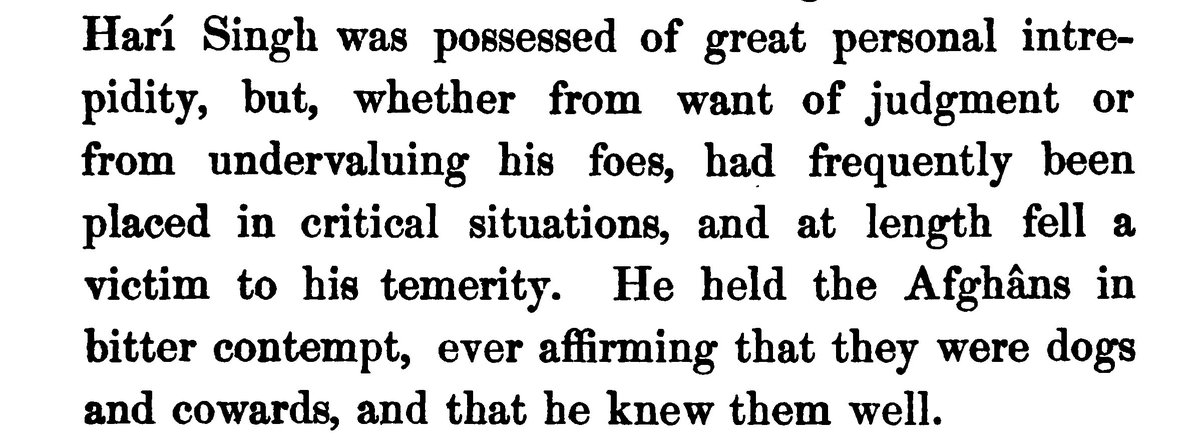
Salman Rashid is carried away by ethno-emotions when he gloats over Hari Singh by saying: "taking Punjabi arms across the Sindhu River and into the Pukhtun heartland". The fact is Hari Singh was a poor general and he jeopardized Sikh hold over Peshawar due to his recklessness. Charles Masson in 1840s writes:


Hari Singh Nalwa


Friday, 26 February 2016

History of Bala Hissar (Peshawar)

Bala Hissar means high fort in Persian. There are several other forts which are also named Bala Hissar. It is unknown as to when the Bala Hissar of Peshawar was erected. Chinese pilgrim, Hiuen Tsang makes a reference to it in 7th century AD when he uses the term "Kung shing" in the description of Peshawar City and its environs which means the "walled portion of the town, in which the royal palace stood". So to say, there was a fort in Peshawar when Hiuen Tsang visited it in the seventh century.

Chronologically the next reference to the fort of Peshawar is found in the Baburnama. Babur put the fort of Peshawar in order, stored corn in it and converted it into a Mughal military outpost. Sometimes after the death of Babur, Dilazak Pashtuns in the Peshawar valley destroyed the Bala Hissar and in 1552 Humayun found it in ruins. The latter rebuilt it and put Sikandar Khan Uzbek in charge of the fort. Later on, Gaju Khan (the head the of the Khashi tribes of Pashtuns) laid siege of the Peshawar fort but he could not capture it.

Bala Hissar under Mughals 

During Akbar's reign, Sayyid Hamid Bukhari was in charge of Peshawar fort and was tasked with guarding the road to Kabul. He was pressed hard by the Roshanias under their leader Jalal al-din Ansari (son of Pir Roshan), popularly known as Jalala. In 1586 Jalala invested the fort of Peshawar. Sayyid Hamid Bukhari suffered a defeat and was killed, and the fort was damaged. The Mughals repaired the fort and continued their struggle against Jalala till his disappearance from the scene. In the period under review, by chance fire broke out in the fort and a thousand camel loads of merchandise was consumed. Faridun was then the commandant of the fort. This incident appears to have taken place after the Roshanias attack on the fort. In 1592, the Pashtuns again invested the fort of Bala Hissar but Zain Khan Koka was able to relieve the fortress. In 1630 the Roshanias struck again and laid siege to Peshawar but could not succeed.

The fort remained in the possession of the Mughal emperors with varying degree of control. With the arrival of Nadir Shah in Peshawar in 1737, the Moghul governor surrendered the valley to him. Nadir Shah crossed the River Indus and concluded a treaty with Emperor Muhammad Shah, according to which the territory west of the Indus was transferred to him. Peshawar thus passed into the hands of Nadir Shah and became a seat of the governors appointed by him. The Governor, it is recorded, held his court at Bala Hissar. In 1747 AD, Ahmad Shah Abdali made full use of the strategic position of the fort and brought the entire Peshawar valley under his complete control. When Ahmad Shah died, his son, Taimur Shah Durrani, succeeded to the throne and made Peshawar his winter capital. The royal residence was, therefore, shifted to Bala Hissar. Raverty records that Shah Zaman Durrani almost entirely rebuilt Bala Hissar, who added to it a Hall of Audience, Zenanah, and various other buildings.

Destruction of Bala Hissar by Sikhs 

The Sikhs captured Peshawar on 20th November 1818. Soon after the occupation of the city, one of the first things that Ranjit Singh did was to set the Bala Hissar on fire, most probably for the reason that it was the seat of the Afghan Kingdom. As regards the destruction wrought by the Sikhs, William Moorcraft, who came here in 1824, records, " in the immediate vicinity of the town (Peshawar) the Sikhs had inflicted more mischief than many years labour could remedy, by destroying gardens and orchards, and demolishing the wells and channels of irrigation. The Bala Hissar, which, at the time of the British embassy, was the occasional residence of the king, and in which their audience took place, was a heap of rubbish, and the only use made of it by the rulers of Peshawar was as a quarry from whence to procure materials for dwellings of their own erection". Thus, many magnificent works of Mughal architecture which once existed in the Bala Hissar were a part of the quarry.

The fort was rebuilt, according to Rai Bahadur Munshi Gopal Das, by Hari Singh after the battle of Nowshera, while Burnes notes that it was rebuilt in the time of Sardar Kurruck Singh. Raverty records, that the present fort was erected by Sher Singh, the son of Ranjit, on his father's orders, and in consequence, whatever remained of the old Bala Hissar was razed to the ground. It was built mostly of unburnt bricks, and was rather imposing in appearance, but of no great strength. The re-erection of the fort by the Sikhs appears to be military in nature as in order to control the Peshawar Valley, they raised fortifications at different places. Peshawar being the headquarters of the area, also needed a fortified place for the same purpose, and the site where formerly stood the Bala Hissar was suitable because of its strategic location. The fort, along with the valley of Peshawar passed into the hands of the British in 1848 AD. who completely renovated it, both internally as well as externally.

References 

1- Journal "Central Asia", 1982, pp.21-23 

2- Peshawar: Historic City of the Frontier, Ahmad Hasan Dani 

 3- The Guardians of the Frontier: The Frontier Corps, N.W.F.P., Mohammad Nawaz Khan 

4- 'Notes on Afghanistan and parts of Baluchistan' by H.G.Raverty 

5- 'Travels in the Himalayan Provinces of Hindustan and the Panjab' by Moorcraft


History of Bala Hissar
Bala Hissar in 1836. Painting by G.T.Vigne.

History of Bala Hissar
Earliest photo of Bala Hissar, taken in circa 1858. By John Burke. Source

History of Bala Hissar
Bala Hissar, Peshawar, 1950


Wednesday, 24 February 2016

Jamrud Fort: From Mughals to Hari Singh Nalwa

At the very mouth of the Khyber Pass stands Jamrud Fort (جمرود قلعہ), located in the lands of the Kuki-Khel Afridis. Constructed in 1836 by Hari Singh Nalwa, it holds historical significance. Although Nalwa's construction is prominent, evidence indicates a Mughal fort existed prior to his fortification.

Origin of the Name Jamrud

The word Jamrud is a compound of two Persian terms: Jam (referring to Jamshed, the legendary Iranian king mentioned in Ferdowsi’s Shahnameh) and Rud (river). Thus, Jamrud literally means “the river of Jamshed.”

Dr. D. B. Spooner, visiting in 1887, wrote:

“I had the pleasure of going up to Ali Masjid in the Khyber in the spring of 1887, and on my way there, of seeing the fort of Jamrud. While there, I heard the tradition, that the fort was connected with the name of King Jamshed of the Peshdadian dynasty of Persia. The late Professor James Darmesteter, when he was in India, visited the place, when at Peshawar a short time before me, and he records as having heard the same tradition.” [1]

Interestingly, another settlement named Jamrud exists about 38 miles from Ghazni, inhabited by the Hazara community.

Jamrud in Early References (Baburnama)

The earliest recorded mention occurs in the Baburnama, memoirs of Zahir-ud-din Babur. Babur describes halting there while crossing the Khyber:

“Crossing Khyber in a march or two, we dismounted at Jam... we broke up our plan of crossing the Sind-water into Hindustan, marched from Jam, forded the Bara-water, and dismounted not far from the pass through the Muhammad-mountain.” [2]

Jamrud as a Mughal Military Outpost

Jamrud served as a Mughal outpost in the 16th and 17th centuries. Explorer William Moorcroft, visiting in 1824, described remains of earlier constructions:

“The plain terminated at the foot of the Khyber range. It appeared to have been formerly a place of importance, from the number of broken stone walls scattered about, and some large tanks, one of which was sixty yards square.” [3]

Between 1674 and 1678, Maharaja Jaswant Singh served as Thanedar (commander) of Jamrud:

“Meanwhile ‘Ruknus Sultanat’ (the pillar of the state) Maharaja Jaswant Singh came from the thana (post) of Jamrud and paid his respects to the emperor (Aurangzeb Alamgir, at Hasan Abdal), who conferred upon the Maharaja a special robe with an elephant worth Rs.20,000/-, sword with studded hilt and seven trays of fruits.” [5]

The Sikh Fort of Hari Singh Nalwa (1836)

The present fort at Jamrud was constructed by Hari Singh Nalwa in December 1836, named Fatehgarh (“Fort of Victory”). Its purpose was to overawe the Afridis. They sought assistance from Dost Muhammad Khan, leading to a battle in April 1837, where Hari Singh Nalwa was killed.

Later Accounts and British Sources

British publications mention Jamrud Fort. The Calcutta Review (1844) confirms Hari Singh Nalwa’s fort was built on an older site:

“The plain terminated at the foot of the Khyber range. It appeared to have been formerly a place of importance…” [4]

Historian Hasan Dani emphasized Jamrud’s significance in his book [6].

References

  1. Asiatic Papers, Vol-II, 1917, p-264
  2. Baburnama, translated into English by A.S. Beveridge, pp.229-230
  3. Travels in the Himalayan provinces…, William Moorcroft, p-345
  4. The Calcutta Review, 1844, p-484
  5. Futahat-i-Alamgiri by Ishwardas Nagar, English translation, p-111
  6. Peshawar: Historic city of the frontier by Hasan Dani, p-195
Jamrud Fort 1860 historical photo showing early structure at Khyber Pass
Jamrud fort, 1860 (c). Photo by Charles Shepherd.
Jamrud Fort 1922 photo depicting Sikh-era fortifications at Khyber Pass
Jamrud fort, 1922. Photo by Lowel Thomas.
Jamrud Fort 1870 historical photo showing Mughal and Sikh fort remnants at Khyber Pass
Jamrud fort, 1870. Photo by William Baker.

Saturday, 29 November 2014

The humiliating defeat of Hari Singh Nalwa at the hands of Mashwani and Saidkhani Pashtuns

The following account of Hari Singh Nalwa’s humiliating defeat at the hands of the Mashwanis and Said Khanis is drawn from two primary sources: (1) an eyewitness account, "Tawarikh-i-Hazara," written by Lala Mehtab Singh in 1846. Extracts from this work were translated into Urdu by Sher Bahadur Khan Panni for his book, "Tarikh-i-Hazara" (pp. 56-59). It is important to note that Mehtab Singh was serving under Hari Singh Nalwa in 1824. (2) The Hazara District Gazetteer, published in 1907, on page 128.

Charles Masson, who traveled through Pakhtunkhwa in the 1830s, wrote that his contemporary, Hari Singh Nalwa, underestimated his Pashtun opponents. Masson noted that Nalwa had frequently faced critical situations even before the disastrous Battle of Jamrud in 1837, where he met his demise and bit the dust. While history has not fully documented all of Nalwa's perilous encounters with the ragtag Pashtun lashkars, one particularly significant defeat in 1824, in the present-day Haripur district, has not been overlooked. The entire 8,000-strong Khalsa Army was vanquished by a small Pashtun force, a stunning upset that even reached the ears of British East India Company officials.

Hari Singh Nalwa had a reputation for being an anti-Muslim bigot and he unnecessarily oppressed and terrorized the unwarlike Muslims of the Kashmir Valley during his brief governorship. Ranjit Singh recognized Nalwa's lack of administrative talent, removed him from governing Kashmir, and decided to utilize him as a formidable force against the warlike and turbulent tribes of Hazara. In 1822, Hari Singh Nalwa became the governor of Hazara and faced the insurrection of a small Pashtun tribe, the Mashwanis, in the same year. His first endeavor to reduce the Srikot hills (located in present-day Haripur district) in 1822 resulted in failure. In 1824 AD, he made another attempt to clear the Gandghar hills of insurgents and conquer the Srikot village of the Mashwanis. He set out from Haripur town with an 8,000-strong army equipped with artillery. At Nara, which stands at the mouth of a path leading up to Srikot, the Sikh army halted and encamped in the empty houses of the village. The Mashwani and Saidkhani Pashtun tribesmen reached Nara, took positions on the hill, and began firing upon the Sikh encampment from above. Sikh officers were reluctant to charge recklessly uphill against the entrenched Pashtun tribesmen and advised Hari Singh to retreat and reassess the situation. This hesitation infuriated Hari Singh, who perceived it as cowardice.

In the evening, Mashwanis and Saidkhanis descended from the hill and attacked the Sikh encampment with jezails, swords, and stones. The Sikh army was unprepared for the daring attack, and disorder ensued. When Hari Singh and Mahan Singh (after whom Mansehra district is named), along with others, emerged from their room, they were assaulted by Pashtun tribesmen with swords and stones. They killed Kishan Singh, Mahan Singh's brother. A Pashtun hurled a stone at Hari Singh Nalwa, striking him unconscious. He rolled into the ravine below and lay there for a long time, undiscovered. Upon regaining consciousness, he managed to return to Kishangarh fort (located within Haripur town). The Sikhs suffered losses of more than 500 men and abandoned a large quantity of arms and camp equipment.

News of the disaster spread throughout Hazara, and rumors circulated that Hari Singh was dead. However, he recovered from his wounds at Kishangarh Fort after several weeks of rest. Eager to dispel the rumors of his demise, he launched a surprise dawn attack on the village of Bagra, about eight miles from Haripur town. The armed Pashtun men there were caught unawares and put to the sword by Hari Singh.

When Ranjit Singh learned of Hari Singh Nalwa's humiliating defeat at Nara, he swiftly marched to Hazara with a large army to rectify the situation caused by his general's failure. He razed the village of Srikot and constructed a fort there, garrisoning it with 500 soldiers. He also conducted a raid across the Indus River. Subsequently, he returned to Lahore. Later, the Mashwanis rose up and laid siege to Srikot Fort. Still reeling from the psychological trauma of his defeat at Nara, Hari Singh was hesitant to engage the Mashwanis. To bolster Nalwa's courage, Ranjit Singh dispatched General Jean-Baptiste Ventura to assist him. The Mashwanis were defeated. Hari Singh Nalwa executed three Mashwani headmen and expelled the Mashwani tribe from Srikot village to prevent the recurrence of the insurgency. The Mashwanis were forced to live in exile on the other side of the Indus River until 1830 when they were allowed to return to Srikot.

A white pillar erected at later date by Major Abbot commemorates the scene of the victory of Mahswanis and Saidkhanis over Hari Singh Nalwa. Contrary to the fanciful accounts of some modern Sikh historians, the Mashwanis and Saidkhanis were not as numerous as ants or locusts. One such writer fantasizes a ten-to-one Pashtun-to-Sikh ratio in that battle, equating to approximately 80,000 Pashtuns against 8,000 Sikh soldiers. However, the 1901 census records only 3,992 Mashwanis in Srikot and 2,564 Utmanzis (of which Saidkhani is a sub-tribe) in Hazara District. It is evident that a small, ragtag force of a few hundred Pashtuns managed to defeat the well-equipped and numerically superior Sikh army of 8,000 regular, European-trained soldiers.

Unlike the Tarins and Jadoons of Hazara, Mashwanis have fully preserved their Pashtun langauge and culture to this day. More can be read about them here. 


Portrait of Hari Singh Nalwah Bahadur Jang, followed in Persian by: 'He has a turban on his head, tied a black shawl around his waist with a hanging dagger and with a soldier standing behind him prepared for action'. Made in circa 1850. Source


Maharaja Ranjit Singh inspecting horses with General Hari Singh Nalwa, Amritsar or Lahore, Punjab, c 1830-32, Toor Collection

Portrait of Hari Singh Nalwa, made by Hasan al-Din in 1845 (c) in Lahore.

Mir Zaman Khan, a Said-Khani Utmanzai of Khalabat. A drawing from 1870s

Mansab Khan, an Utmanzai Afghan, a resident of Char in the Tarbela region (in present-day Haripur district). A drawing from 1870s