Showing posts with label 17th century AD. Show all posts

Friday, 3 June 2022

Darya Khan Daudzai

Darya Khan Daudzai was a horse trader from a village near Peshawar who later joined the Mughal service and became a high-ranking Mughal mansabdar. In 1630, he joined the rebellion of Khan Jahan Lodi and was a key figure in convincing the latter to make it a cause for ending Mughal rule in both India and Afghanistan. Their efforts were unsuccessful, and they suffered defeats at the hands of the Mughals.

After these failures, a large number of Pashtuns deserted Khan Jahan Lodi, leaving him with a small army. However, Darya Khan Daudzai stuck with Khan Jahan Lodi to the end. On the advice of Darya Khan Daudzai and some other Pashtun nobles, Khan Jahan Lodi decided to move to Punjab to get help from the Pashtuns of Pakhtunkhwa. Since all roads to Punjab through Malwa were blocked by Mughal forces, Khan Jahan Lodi decided to push on to Kalpi through Bundela territory.

During a journey through Bundela territory, now part of modern Uttar Pradesh, the rear guard of Khan Jahan Lodi's army was ambushed by the forces of Bikramajit Bundela, acting on behalf of his Mughal sovereign. Darya Khan Daudzai, commanding the rear guard with just 400 soldiers, chose to engage the attackers to allow Khan Jahan Lodi to escape. Darya Khan was fatally shot in the head by a musket ball, and all 400 Pashtun soldiers, including one of his sons, died heroically in the battle. Bikramajit then severed the heads of both Darya Khan and his son and sent them to the Mughal court. Thanks to the sacrifices of Darya Khan Daudzai and his men, Khan Jahan Lodi managed to escape on this occasion, though a month later, he and his entire family also perished in battle.

References: (1) Padshahnama by Abdul Hamid Lahori (2) Maathir-ul-Umara by Shah Nawaz Khan (3) Zakhirat al-Khawanin by Shaikh Farid Bukhari.

The following painting is attributed to Balchand who was one of the many Hindu painters working under the Mughals during the reigns of both Jahangir and Shah Jahan.

Mughal painting of Darya Khan Daudzai being executed by Bundela Rajputs
A detail from Mughal painting of circa 1631 depicts Darya Khan Daudzai having his head cut off by Bundela Rajputs. Source
Rear of Khan Jahan Lodi's army ambushed by Bikramajit Bundela
‘Bikramajit’s Victory over Darya Khan in 1631’. The painting depicts the rear of Khan Jahan Lodi's army getting ambushed. Source
Pashtun soldiers detail
Detail of Pashtun soldiers
Pashtun soldiers detail
Detail of Pashtun soldiers

Thursday, 27 January 2022

Painting of Abdul Karim Khan Miyana (Pashtun) titled Bahlul Khan of Bijapur hunting on horseback

Painting of Abdul Karim Khan Miyana (Pashtun) titled Bahlul Khan, a noble of Bijapur sultanate, hunting on horseback, with elephants and cavalry. Source


Abdul Karim Khan Miyana titled Bahlul Khan became Commander-in-Chief of the army of Bijapur sultanate, and later served as regent for the child king Sikandar Adil Shah (r. 1672-1686.

Sunday, 23 January 2022

Portrait of Nawab Daler Khan Miyana (Pashtun)

Portrait of Nawab Daler Khan Miyana (Pashtun). Source


Portrait of Nawab Abdur Rauf Khan Miyana (Pashtun) titled Daler Khan. Undated. 

He was son and successor of Bahlul Khan Miyana (who served as Commander-in-chief of the army of Bijapur sultanate). After the fall of Bijapur sultanate, Abdur Rauf Khan Miyana entered into the service of Mughals. Mughal emperor Aurangzeb awarded him the highest mansab of 7,000 zat and the title "Daler Khan" in 1686. 

1- The Miyana tribe belongs to the Saraban division of Pashtuns. They are found in Baluchistan province of Pakistan. Luni, Jafar, Zmari and Gharshin tribes are remnants of the Miyana tribe. 

2- Bijapur sultanate was located in south-western India, straddling the Western Ghats range of southern Maharashtra and northern Karnataka. It was ruled by the Adil Shahi dynasty from 1490 to 1686. After the fall of Bijapur sultanate and decline of Mughal empire, the Miyanas established their own principality at Savanur (now part of Karnataka state of India) which became princely state of British-India in 19th century.

Saturday, 1 January 2022

The Miyana (Afghan) nobles of Bijapur sultanate

The Miyana tribe belongs to the Saraban division of Pashtuns. They are found in Baluchistan province of Pakistan. Most of its branches have become extinct or have lost their identity. Their en-mass migration to India greatly weakened them and they fell easy prey to their Baloch neighbours. Luni, Jafar, Zamari and Gharshin tribes are remnants of the Miyana tribe.  

Some of the Miyanas became nobles of the Adil Shahi Sultans of Bijapur (1518-1686). Jan-Nisar Khan Miyana held the rank of 2,000 horse in the reign of Ismael Adil Shah who ruled from 1510 to 1535 AD. Bahlul Khan Miyana, a descendant of Jan-Nisar Khan Miyana, became Commander-in-Chief of the army of Bijapur sultanate, and later served as regent for the child king Sikandar Adil Shah (r. 1672-1686).

Bahlul Khan Miyana died in the reign of Sikandar Adil Shah. He was succeeded by his son Dalil Khan Miyana who kept on good terms with Sikandar Adil Shah, but when Aurangzeb again entered the Deccan in 1681 AD for its subjugation, Dalil Khan joined him with 2000 Afghan cavalry and 3000 foot, many of them of his own tribe, and all in his own pay.

References: (1) "Notes on Afghanistan and part of Baluchistan" by H.G.Raverty (2) "History of the Pathans" by Haroon Rashid.


Portrait of Bahlul Khan Miyana, made in c.1686 by an anonymous artist. Source
Portrait of Abdul Aziz Khan Miyana, brother of Bahlul Khan Miyana. Source

A portrait of Bahlul Khan Miyana, late 19th century painting. Source

Portrait of Nazar Bahadur Khweshgi (Pashtun)

Portrait of Nazar Khan Khweshgi (Pashtun). Source


Nazar Bahadur Khweshgi was born in the Pashtun colony of Kasur in Punjab. He was a noble of Mughal empire in the reigns of Jahangir and Shah Jahan. He reached the mansab of 4,000/4,000.

The Khwesgi Pashtuns had accompanied the army of Mughal king Babur in 1526 and had fought on his behalf against the army of Sultan Ibrahim Lodi. As a reward for their services, Babur granted them the present territory of Kasur as jagir. They were regarded with favour by Mughal emperors and many of them attained high ranks in the Mughal nobility.


Wednesday, 29 December 2021

Mausoleum of Shaikh Imam al-Din (a Khalil Pashtun), Palosai, Peshawar

Mausoleum of Shaikh Imam al-Din (a Khalil Pashtun), Palosai, Peshawar. 

According to Persian inscription on the site, Shaikh Imam al-Din died in 1650 AD and the mausoleum was constructed in 1653 AD. 
 
He was grandson of Shaikh Qasim Sulaimani, a renowned saint of Akbar's reign.


Friday, 15 October 2021

An inscription in Maharashtra state of India dated to 1626 AD mentions the toponym Afghanistan

An inscription in Mangrul (Sangli district, Maharashtra state, India) dated to 1626 AD mentions the toponym Afghanistan. 

The geographic term Afghanistan of early 17th century corresponded with the Pashtun belt or Pakhtunkhwa. It stretched from Swat to Sibi (a town in Balochistan province of Pakistan), and from Kabul to Hasan Abdal (a town in the Attock district of Punjab province of Pakistan). It was also referred to as Roh.


Thursday, 29 July 2021

A Turkoman who killed more than one thousand Pashtuns by boiling them alive in large cauldrons


In 1610s, the Mughal governor of Siwi fort (i.e. Sibi fort in modern Baluchistan, Pakistan) killed more than one thousand Pashtuns by boiling them alive in large cauldrons to create awe and terror in the hearts of the unruly population.

The name of that Mughal officer was Quje Ali and and he was a Turkoman by race. He kept two big cauldrons of boiling water perpetually ready and would throw those people into it who he would deem as malefactors. 

However, he could not subdue the Panni tribe of Pashtuns through terror. He was perpetually engaged in wars with Panni Pashtuns until he was recalled to India. His successor, Shaikh Bol, was killed by Panni Pashtuns in 1617. 

References: 
 
1-'Zakhiratul Khawanin' by Shaikh Farid Bukhari 
2- Tarikh i Mazhar Shahjahani


Saint Eulampia and her brother are boiled alive in oil and the torture of Saint Rufina of Rome. Origin: Amsterdam. Date: 1700. Creator: Jan Luyken


 Ruins of Siwi or Sibi fort (erroneously referred to as Mir Chakar fort) :


Sibi district


Saturday, 8 August 2020

Hatimpur fort (a 17th century fort built by a Niazi Pashtun)

During the reign of Mughal emperor Aurangzeb, a family of Pashtuns rose to prominence in the Ghazipur region of modern Uttar Pradesh (India). Four brothers (Niazi Pashtuns) Ghous, Hatim, Pahar and Inayat were in the service of the army of viceroy of the province. The wife of the Viceroy accompanied him on one of his military expeditions. It so happened, that in the hurry and confusion of a sudden march, her palanquin was left behind in a forest. The Pashtun brothers came up, and finding the lady thus deserted, they took up her palanquin, and with the utmost courtesy conveyed her in safety to the camp of the Viceroy. In return for this service permission was given them to settle in the Ghazipur District. They first tried to establish themselves at Beerpur near Chowsa ; but the Zemindars there showed so much inclination to fight, that the brothers gladly compromised matters by accepting from them a sum of money and departing to try their fortune elsewhere. Ghous Khan settled close to Kuttote and built the village of Ghouspur.

The other brothers settled in Pergunnah Mahaitch, and became the owners of eleven villages, which still bear their names. A remarkably fine fort was built by Hatim Khan in his village Hetimpur, which is the most striking ancient building in the district. [Reference "Historical and Statistical Memoir of the Ghazeepoor District]


Ruins of Hatimpur, a 17th century fort built by Hatim Khan Niazi (a Pashtun), Chandauli district, (U.P, India). Photos taken by Archeological survey of India Department UP, on request of Mohammed Zober Neyazee.


Thursday, 28 November 2019

Sikhs adopted blue coloured dress towards the end of 17th century in the memory and honour of a group of Pashtuns

A group of blue-clad Pashtuns left a lasting impression on Guru Gobind Singh (1666-1708). According to Siyar-ul-Mutakherin, once when Guru Gobind Singh (the founder of Khalsa) found it difficult to cross the territory of Sirhind, he hired Afghan (Pashtun) mountaineers in the vicinity of Sirhind to escort him to his family and promised gold for doing so. Those Afghan mountaineers engaged him to let grow his whiskers and beard to certain length, and they dressed him in blue in the style of the Afghans of that region. They escorted him with perfect safety and honour. Whenever any one asked who he was, they would answer that he was a Pirzada of theirs. It left a great impression on Guru Gobind Singh and he retained the Afghan garb in memory of that event, and he even made it henceforth the distinctive garb of his followers. He also directed his followers to grow their hair and beard. [See "Seir ul-Mutaqherin" (completed in 1780), English translation, vol-1, p-91].

The Rohillas (Indo-Afghans) usually wore blue-coloured dress in India. The author of "The people of India" (1868-1875) writes: "The "Rohilla" costume in the Deccan is a blue cotton shirt, white or blue drawers, and white, red, or blue turban, with a blue quilted jacket for cold weather."

This tradition is understandably not reported by Sikh writers of Runjeet Singh times because the Khalsa in 18th and early 19th century regarded Pashtun Muslims as their enemies and would have this tradition best forgotten. 

Banda Singh Bairagi (an anti-Muslim fanatic) attempted to suppress the blue-coloured dress [1], may be because he was irked by the fact that it was adopted in memory and honour of Muslim Pashtuns. Banda Singh had suffered defeats at the hands an Orakzai Pashtun [2] as well as an Indo-Afghan of Kasur.

Portrait of Phula Singh Akali, 1850 (c).

Rohilla men, c1850. British Libray

A Bangash Pashtun in blue dress, c.1827-1843. By Imam Bakhsh Lahori, Illustrations des Mémoires du général Claude-Auguste Court, Lahore. Source

Afghans of Jalalabad dressed in blue, 1842's painting. Source

"Ruhela Pathan Seized by Jat" By Sanee, Company School, c1870-80. Source


Saturday, 29 April 2017

Notes on Orakzai tribe

Origin legend

According to the legends prevalent amongst the Orakzai elders, Tirah was formerly occupied by the Hindu non-Pashtun race, called the Tirahis whose descendants are, to this day, found in some villages as 'Hamsaya' (dependents) of the Orakzai. Tirahis were ruled by different rajas whose names can still be traced in several places in Tirah such as the Rajgal valley, Darbar Ghundi and Moula Ghar, named after King Rajgal, Raja Darbar and Raja Moula respectively.

White King conjectures that about 1,000 years ago, a Persian Prince, Sikandar Shah, captured the Tirah region, and he is considered by some as the ancestor of the Orakzai tribe. As the legend goes, Prince Sikandar, in his own country used to amuse himself by breaking the pitchers carried by the women drawing water from the springs near his palace in Isphahan, a hobby of majority of the princes of old legends. The people complained to the king about the prince's leisure-sport who chided the prince, but to no avail. The prince continued his sport and one fine morning he, to his dismay, found that his shoes had been turned upside down, meaning thereby his expulsion from the kingdom. He was henceforth known as the, 'Wrukza', that in Pashto means 'get lost or be exiled'. The prince left his country and came to Urghan in the Waziristan territory, the capital of the Muhammadan King of Kohat, who gave him employment at his court. After sometimes, the Persian King repented his action and sent a court musician (Dum) named Banga to bring back the exiled prince. Banga had been the prince's friend since childhood. In course of time, Banga found his way to Kohat where Sikandar Shah welcomed him, called him his brother and gave him a seat next to him in the royal durbar. From Banga, the King at Kohat learned that Sikandar Shah was exiled son of the King of Persia. The King married to him one of his daughters. At about that time, the Tirahis started raids on the suburbs of Kohat; consequently, the King of Kohat sent Prince Sikandar Shah to subdue the Tirahis. He set out by the Tora Pakha route and reached Tanda in the Mastura valley. He defeated the Tirahis and drove them into the Maidan of Tirah and thereafter across the mountains of Nangarhar where their descendants are still said to be settled. In the meantime, the King of Kohat died and Banga established himself as the new King of Kohat. Sikandar Shah fought Banga's forces at Muhammadzai, near Kohat and was defeated. So, Sikandar Shah was obliged to settle down in Tirah where he established himself and married a Tirahi woman as his second wife. From Banga originated the Bangash tribe of Kohat. Sikandar's descendants were called by their neighbors as the sons of 'Wrukza' which got corrupted into Wrukzai or Orakzai.

(Reference: "History of the Pathans" by Haroon Rashid, Vol-IV, p-52

Conflict with the Mughals

In 1619 or 1620, Mahabat Khan, Subahdar of Kabul, under the emperor Jahangir, treacherously massacred 300 Daulatzai Orakzai, who were Roshania adherents; and, during his absence on a visit to Jahangir at Rohtas, Ghairat Khan was sent with a large force via Kohat to invade Tirah. He advanced to the foot of the Sampagha pass, which was held by the Roshanias under Ihdad and the Daulatzai under Malik Tor. The Rajputs attacked the former and the latter were assailed by Ghairat Khan's own troops, but the Mughal forces were repulsed with great loss. Six years later, however, Muzaffar Khan, son of Khwaja Abdul Hasan, then Subahdar of Kabul, marched against Ihdad by the Sugawand pass and Gardez, and after five- or six-months' fighting Ihdad was shot, and his head sent to Jahangir. His followers then took refuge in the Lowaghar; and subsequently Abdul Kadir, Ihdad's son, and his widow Alai, returned to Tirah. The death of Jahangir in 1627 was the signal for a general rising of the Afghans against the Mughal domination. Muzaffar Khan was attacked on his way from Peshawar to Kabul, and severely handled by the Orakzai and Afridis, while Abdul Kadir attacked Peshawar, plundered the city, and invested the citadel. Abdul Kadir was, however, compelled by the jealousy of the Afghans to abandon the siege and retire to Tirah, whence he was induced to come into Peshawar. There he died in 1635. The Mughals sent a fresh expedition against his followers in Tirah; and Yusuf, the Afridi, and Asar Mir, the Orakzai chief, were at length induced to submit, and received lands at Panipat near Delhi. Simultaneously operations were undertaken in Kurram. Yet, in spite of these measures, Mir Yakut, the imperial Diwan at Peshawar, was sent to Tirah in 1658 to repress an Orakzai and Afridi revolt.

(Reference:  Imperial Gazetteer of India, Provincial series: North-West-Frontier", page-235)

Orakzai notables in India, Dost Muhammad Khan and Jalal Khan

Dost Muhammad Khan, born in 1672 A.D, was the son of Nur Muhammad Khan, and belonged to Mirazi Khel clan of Orakzais of Tirah. He emigrated to Hindustan, somewhere between 1697 and 1703, during the final years of Emperor Aurangzeb Alamgir. He founded the Bhopal principality in 1707 and expanded it till his death in 1728. At its zenith, the Bhopal state comprised a territory of around 7,000 square miles (18,000 km2). The state became a British protectorate in 1818 and was ruled by the descendants of Dost Mohammad Khan till 1949, when it was merged with the Dominion of India.

Jalal Khan 's father, Hazar Mir Orakzai of Miranzai Khel, came to India during the reign of Emperor Shah Jahan and obtained the zamindari of certain villages in the Jamuna-Gangetic Doab. After his father's death, Jalal Khan succeeded to the zamindari and obtained, in addition thereto, some more villages in the pargana of Thana Bhawan, near which he built a fortress and founded the town of Jalalabad (Saharanpur, U.P). In 1709 Jalal Khan faced seventy or eighty thousand Sikhs of Banda Singh and successfully defended his fort with just few hundred men. For the victory over the Sikhs, Jalal Khan was rewarded by the Nazim of Delhi, on 31st August 1710 AD, with the Faujdari of Saharanpur. He was raised to the rank of two thousand and five hundred in the reign of Jahandar Shah, with a further promotion during Farrukh Siyar's time. He died in September 1718 AD.

Orakzais during the Durrani period

Since the decay of the Mughal empire, Orakzai tribes had been virtually independent, though owning at times a nominal allegiance to Kabul. Syed Ghulam Muhammad in Timur Shah's reign, has following description of Orakzais;

 "The Afghan tribe (Orakzai) contains some thousands of families, and they dwell in mountain tracts of Tirah, the Khyber, and Jalalabad. They have to furnish a contingent of soldiers to the Badhshah of Kabul, and their Sardars hold jagirs or fiefs in the Peshawar district for guarding and keeping open the passes within their boundaries." (Reference: Raverty, "Notes on Afghanistan", p-95)

During the Durrani period, the titular chief of the Orakzai belonged to the Abdul Aziz Khel clan. He had very cordial relations with the Saddozai Kings at Kabul. The Abdul Aziz Khel 'Khan Khels' had a 'sanad' from Ahmad Shah Abdali , granting them a 'jagir' and some monetary allowances. In 1796-7 AD, Orakzais provided an infantry contingent of ten thousand men to Zaman Shah for his invasion of the Punjab. The Durranis, from the very beginning , managed the Orakzai tribe through the Bangash 'Khans' of Hangu. During the Barakzai and Sikh domination of the area, the Orakzai were under the management of Sultan Muhammad Khan Barakzai, the governor of Kohat.  (Reference: "History of the Pathans" by Haroon Rashid, Vol-IV, p-70)  


Islamnagar Palace, Bhopal, built by Dost Mohammad Khan Orakzai

Orakzai tribesmen, 1861

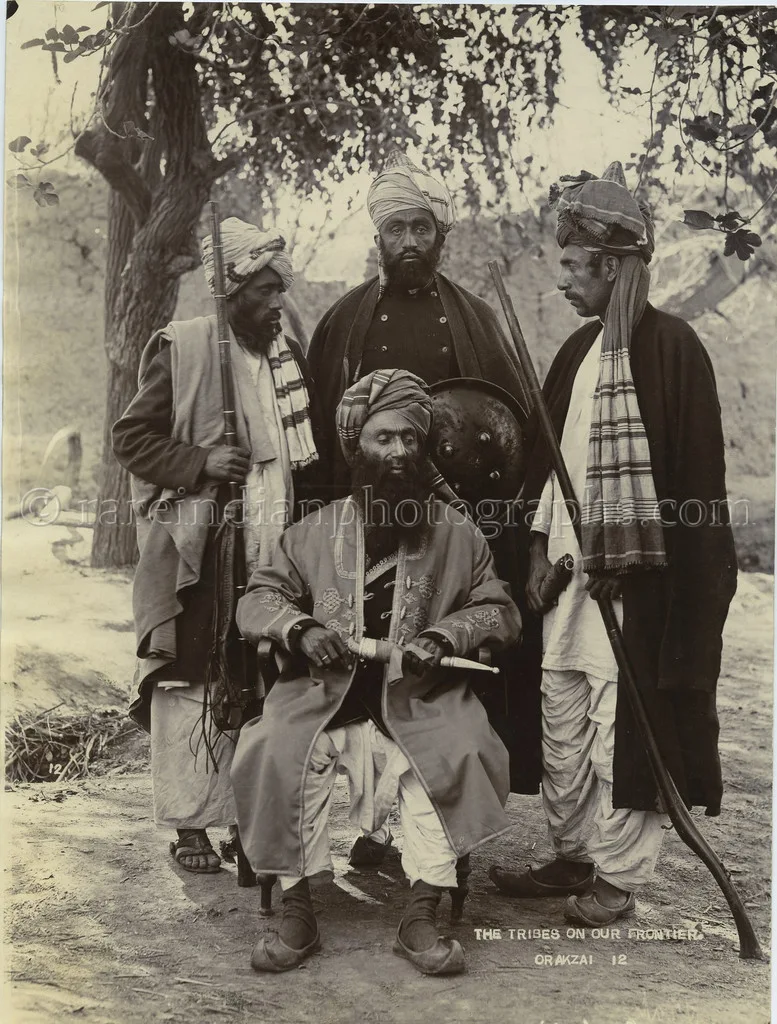
Group portrait of an Orakzai Chief and three tribesmen, ca. 1900, , the Chief sits in an armchair wearing a striped turban, an embroidered woolen full-length embroidered coat over a velvet gold-embroidered waistcoat, he wears baggy Pathan pants and traditional leather shoes with curling toes, he carries a Khyber knife in its scabbard with metal locket and chape, the three tribesmen around him are armed with jezail matchlocks, Khyber knife and a metal shield dhal with 4 bosses. This image was published by the Arts Photo Works of India as `Our restless neighbours the Pathans’

https://blogger.googleusercontent.com/img/b/R29vZ2xl/AVvXsEiidAR2cxpCGkhLS1-v1wb7zad9hfi51eM8n4x7YP6drq_KxishafDEHcFgXVWP7KcVflv-3R__EV9jM3ZZ3xXWQ49-hm92GX0rB-RDPNczm89DRZmWskKtVcWYnOFoY_HRPgTyZrKccQOx/s1600/1.jpg


Inhabitants of Khyber : Shinwari , Afridi and Orakzai, 1827-1843. By Imam Bakhsh Lahori.


See also : Jalal Khan Orakzai

                 When Orakzais defeated the Mughal army in Tirah


Thursday, 21 July 2016

Diler Khan Daudzai (a general of Aurangzeb Alamgir)


Nawab Diler Khan Afghan. Painting by Mihir Chand in 1770 A,D, placed in the Chester Beatty Dublin. Source


Diler Khan, whose proper name was Jalal Khan, had reputation of being one of the best and bravest generals of the Mughal emperor Aurangzeb Alamgir. Bhimsen Saxena (a Hindu soldier who served under Aurangzeb) praise his military talents as follow:-
"Dilir Khan Afghan, the holder of the punj-hazari rank, surpassed and excelled all the contemporary nobles in the arts of his swordsmanship and leadership. He knew the tactics and techniques and the rules of discipline and order of warfare very well. Wherever he went, he was greeted by success and victory. " [1]

Mughals distrusted the Pashtuns and very few of them were given the rank of 5,000. Niccolao Manucci remarks, "It is a rule in the Mughal empire not to trust the race of Pathans" [2]. Aurangzeb elevated Diler Khan to 5,000 in acknowledgement of his services against Shivaji. But Diler Khan had a chequered military and political career and he suddenly died in 1683 under mysterious circumstances.

Diler Khan belonged to the Baqalzai (or Baqarzai) branch of the Daudzai tribe of Peshawar valley. His father Daya Khan hailed from village Barbar (in the present-day Peshawar district) and was a horse trader [3]. Barbar is situated at a distance of about six miles to the north of Peshawar City and is attached to the Mathra Police Station. [4]

Darya Khan (Diler Khan's father) was introduced at the court of emperor Jahangir by Khan-i-Jahan Lodi and on his recommendation the emperor granted him the rank of 3000 Zat and 3000 Sawar. Darya Khan joined Khan Jahan Lodi in his rebellion and was killed in a fight in 1630. His sons Bahadur Khan and Jalal Khan (Diler Khan) also entered into the Mughal service.

Shahjahanpur was founded by Diler Khan in 1647 as a deputy of his brother Bahadur Khan. Bahadur Khan who was campaigning in Balkh at that time, persuaded the Pashtuns of the Roh to migrate to Shahjahanpur district. Soon it became a strong Pashtun settlement [5].

The town of Shahabad in Hardoi district was founded by Diler Khan in 1677.


A full length portrait of Daler Khan Rohilla (Daudzai), 1670 (c). Source 

Portrait of Daler Khan (a Daudzai Pashtun), a noble of emperor Aurangzeb, c.1686. By an anonymous artist. Source

Portrait of Nawab Daler Khan Daudzai (Pashtun). Source


Tomb of Diler Khan in Shahabad


Jama Masjid Shahabad, built by Diler Khan


References:

1- "English translation of Tarikh-i-dilkasha (Memoirs of Bhimsen relating to Aurangzib's Deccan campaigns", p-141
2- "Storia Da Mogur", Vol-II, p-241
3- "Nama-i-Muzaffari", by Muhammad Muzaffar Hussain, p-7
4- "On a Foreign Approach to Khushhal", Dost Muhammad Khan Kamil, p-14
5- "The Afghan nobility and the Mughals", Rita Joshi, p-128


Saturday, 21 May 2016

When Pashtun tribesmen wiped out an entire Mughal army in the Khyber Pass (1672)

In 1672 AD, a small incident triggered a huge war in Pakhtunkhwa. In that year some Mughal troops stationed in Kunar insulted a Parachi woman who was there to sell and buy. Some Pashtun men belonging to Safi tribe witnessed that and killed those troops for insulting that woman. Hussain Beg Khan, the Mughal faujdar of Jalalabad, called upon the chiefs of the Safi tribe to deliver the men involved in the attack on his men. They refused to do so. Other Pashtun tribes subject to the Kabul government were summoned to join him in punishing the Safis. The local Pashtun tribes, mostly Mohmands, being duty-bound, attended him but sent a word to the Safis that they had acted like men and that they would not draw their swords for the Mughals against them but would remain passive spectators. This they did and Hussain Beg Khan was completely defeated. He then attempted to seize the chieftains of the Pashtuns along with him, but their clansmen crowded around him and prevented it. On this he sent an exaggerated and one-sided report to Muhammad Amin Khan, the subahdar of Kabul, who was then at Peshawar to spend winters. Fatuhat-i-Alamgriri (a contemporary account of the reign of Aurangzeb) records the incident in the following manner:

"It so happened that Mirza Ali Beg , the faujdar of Jalalabad, on behalf of the Khan , treated the Pathans of the district (zila) badly and that tribe, which exceeded the locusts and ants, and was united among themselves and hostile to the outsiders, collected from every nook and corner, held consultations with each other and decided that the road to Kabul should be blocked so that Umdat-ul-Mulk many not be able to get (there)."


Muhammad Amin Khan was exceedingly arrogant and overbearing; no one dared to give an opinion contrary to his wishes, and he was much disliked. The Hussain Beg Khan, likewise, was not held in much esteem by the Pashtuns. It is related that on one occasion, when about to march from Jamrud to Kabul, the Pashtun chiefs of the mountains came to pay their respects to the representative of their ruler. He was intoxicated at that time , and Hussain Beg Khan was with him. The latter, seeing the Pashtun in attendance, said to him, "The Nawab's dogs desire to make their obeisance". This speech afterwards came to the ears of the Pashtuns and roused their indignation still more against the Mughals.


At the time this report reached Muhammad Amin Khan, he had started for Kabul with his army and entourage, accompanied by their families and household property. The news of the insult of the woman affiliated to Safi tribe spread amongst the Khyberi tribes. The Shinwaris,  Mohmands and Afridis resolved to oppose march of Muhammad Amin Khan through the Khyber, and they took post in the Landi Khana Kotal. According to Mughal historian Khafi Khan, the rising was headed by Aimal Khan and other Afghan heads. Muhammad Amin Khan was also accompanied by Mustajab Khan Mohmand, the Arbab of Peshawar, Khushal Khan Khattak and some chiefs of the Afridis and Orakzais.


 Sir Jadunath Sarkar writes:

"The Afridis rose under their chieftain Aemal Khan, a born general, who crowned himself king, struck coins in his own name, and proclaiming war against the Mughals, summoned all the Pathan clans to join the national movement. With a following more numerous than ants and locusts, he closed the Khyber Pass."


Arbab Mustajab Khan Mohmand was sent to negotiate with the insurgents. The negotiations failed. The Pashtuns had blocked Landi Khana Kotal with sangars and breastwork. Muhammad Amin Khan tried to force his way through the pass and sent a body of veterans under his son Abdullah, and other high officers, Mubariz Khan and Mahmud Khan Kheshgi (an Afghan of Hindustan) to attack the Pashtuns. When the Mughals approached the breastworks, the Pashtuns launched great stones or boulders down upon the Mughals. The elephants were forced back, Mahmud Khan Kheshgi was killed, and his troops were repulsed with great loss. Mubariz Khan also failed miserably and was also forced back. The Pashtuns pounced upon the retreating Mughals with their swords and daggers with disastrous effect. 


The fighting, after a short time, was again renewed and the battle raged for one whole day but Mughals could not gain anything against the Pashtuns. The Afridi and Orakzai allies of the Mughal subahdar kept aloof. But Khushal Khan Khattak along with his men fought hard for the Mughals. Horses, elephants and men were mixed up in the confusion and disorder seized the Mughal army. The Mughal army was routed. The shattered Mughal army proceeded in the direction of Tararrah where they were again attacked by the Pashtuns. This completed the destruction of Mughal army. For three days i.e 18th, 19th and 20th April, the massacre and loot continued.


Amin Khan was completely defeated. He lost everything - troops, treasure, elephants, family including his wife, mother, sister, son, daughters, and brothers-in-law, as well as the wives and families of the other Mughal nobles. Khushal Khan Khattak chimes:


اول جنگ د لوړو شا د تهترو و

چې څلوېښت زره مغل شـول تار په تار

خويندې وروڼه يې بندې د پښتنو شوې

اس، اوښان، هاتيان، ولجـه قطار قطار


"The first fight was at the higher back of Mount Tatarah, when forty thousand Mughals were scattered like chaff. Where their sisters and daughters fell into the hands of the Pashtuns, with horses and camels, elephants and baggage, string after string."


According to Fatukhat-i-Alamgiri:

"In short 10,000 soldiers fell in this expedition and about two crores of rupees in cash and kind was looted by the Afghans. They captured 20,000 men and women, whom they sold in Turan and Central Asia. "


Utterly humbled and exhausted, Muhammad Amin Khan and some of his high officers succeeded in escaping to Peshawar with bare lives and everything else was lost. A Pashtun 'Jemadar' brought Amin Khan via a secret route. Mannuci writes:


"Muhammad Amin Khan ordered his secretary, Muhammad Riza, to take the seat on his elephant, and thus he was destroyed, the Pathans supposing that it was Muhammad Amin Khan himself. They contented themselves with cutting off this man's head and carrying it into the mountains. Muhammad Amin Khan, with the aid of some Pathans in his service, clothed himself in their manner, and these men conducted him until he had got out of the hills and arrived at Peshawar." 


Khushal Khan Khattak in his diary says:

"When on the first of Muharram 1083 H, Muhammad Amin Khan's army was routed in Khyber, both Mustajab and I were with him. We escaped via Tahtarah and came to Peshawar. Muhammad Amin Khan, attended by a few horsemen, had already reached Peshawar. The whole of his family as well as the train was lost. His mother, sister, daughter and attendants were made captive. His wife was killed. His son and brother-in-law were also killed. I was very ill and had still to cover the distance sometime walking and sometime riding through the Tahtarah mountains and was thus completely exhausted. I therefore sent Ashraf Khan to wait upon Muhammad Amin Khan. He was in woeful condition , bewildered and perplexed. Conferring with Ashraf Khan he inquired about me and said to him, ' Also convey my Salam to your father saying i am glad about his safe return and pray to God for is recovery from illness. Also tell him to come to me if he can".


After paying a large amount of money to the Pashtuns, Amin Khan got released his youngest daughter who was just a child , his mother and some other females.


Returning to Peshawar, Muhammad Amin Khan took base revenge for the consequences of his own folly. In anger he killed Arbab Mustajab Khan Mohmand, one of the chief men of Peshawar. According to Fatuhat-i-Alamgiri, Mustajab, in his death agony, cried out for a little water to drink. Muhammad Amin Khan answered, "Many Muslims have died of thirst. It is not wrong that you should die of the same cause, as reparation for it"


This signal victory increased the prestige and resources of Aimal Khan Mohmand. The tale of his rich booty spread through out the hills and lured recruits to his banners.


Muhammad Amin Khan , son of Mir Jumla


Portrait of Muhammad Amin Khan, 1685 (c). Source


References: 

1- "Notes on Afghanistan", H.G.Raverty, p-42
2- "On foreign approach to Khushal", Dost Muhammad Kamil, p-
2- "History of the Pathans" by Haroon Rashid, Vol-IV, pp-171-177
3- "History of Aurangzib", Jadunath sarkar, Vol-III, p-150
4-  Storia da Mogor, Vol-II, p-200
5-  Fatuhat-i-Alamgiri, pp.103-106


 the Mughal governor of Kabul whose entire army got defeated and destroyed by Aimal Khan Mohmand in the Khyber Pass in 1672. By anonymous artist, made in circa 1685. He was son of immensely wealthy Iranian/Persian nobleman Mir Jumla.

Thursday, 14 January 2016

Rashid Khan Ansari (Allahdad Khan)

Rashid Khan Ansari (Allahdad Khan), a grandson of Bayazid Ansari (Pir Roshan), was one of the important noble of Jehangir and Shah Jahan. When Jalala, the Bayazid Ansari's son, died in 1601 A.D, he was succeeded by his nephew Ahdad Khan, superseding the right to succession by his son Allahdad Khan. While Ahdad continued his resistance, Allahdad was won over by Jehangir. How Allahdad Khan changed side, is not clear, however in January 1615 A.D Jehangir records honoring him with a jeweled dagger for his becoming loyal. Jehangir kept on rewarding Allahdad Khan, but Allahdad was still suspicious of Jehangir's real intentions: one of the reasons might have been the fact that his son Jalal was still kept as hostage at the imperial court. Allahdad Khan rebelled, but shortly afterwards he surrendered at the instance of Khan-i-Dauran , he was given the title of Khan and promoted to the rank of 2,000 Zat and 1,000 Sawar. Hereafter Allahdad continued to serve Jehangir and Shah Jahan with loyalty and devotion. He was given the title of Rashid Khan in September 1617 by which he is known generally. 
 

After ascending the throne, Shah Jahan conferred on him the rank of 3,000 Zat and 1,500 Sawar, and shortly afterwards he was deputed to pursue rebellious Jujhar Singh under the supreme command of Mahabat Khan. Being hotly pursued by the imperial army, and seeing no way out, Jujhar Singh submitted before Emperor and his offenses were pardoned. He was reinstated but some portions of his Jagir was confiscated and distributed among Mahabat Khan, Rashid Khan Ansari and others. Consequently, at the occasion of Nauroz celebration, his rank was raised to 3,000 Zat and 2,000 Sawar. In 1631, he was sent to the Deccan with Azam Khan, the viceroy of Deccan. One day while Azam Khan was pitching his camp on the bank of Manjira River, he was surprised by Randola Khan. In this engagement a number of Mughal commanders including Shahbaz Khan Ruhela were killed, and Bahdur Khan and Yusuf Khan were made prisoner. However, Rashid Khan, who was severely wounded, succeeded in escaping from the battlefield. 

In 1634, he was chosen to accompany Prince Shuja to besiege the fort of Parenda , though Parenda campaign was unsuccessful, but Rashid Khan Ansari gave ample proof of his military skill and received an increase of 1,000 Sawar, so that his mansab became 3,000 Zat and 3,000 Sawar. After Parenda campaign, he continued to serve in the Deccan in various capacity. Later on, in appreciation of his services in the Deccan, he was elevated to the rank of 4,000 Zat and 3,000 Sawar. The author of Zakhiratul-Khwanin writes that Rashid Khan rose into prominence for his sincerity and achievements in the frontier region. In Deccan, the prince didnt take any decision without consulting him. Rashid Khan set a good example of fine administration and rendered valuable service in suppressing the Marathas. He enjoyed the confidence of the emperor and had a large following of Pashtuns. Mahabat Khan became apprehensive of some of his activities and represented to Shah Jahan that Rashid Khan had a strong Afghan following and was so endowed with intellect and courage that he might become presumptuous. He advised the emperor to recall him from Deccan. He also suggested that Khan-i-Zaman should not be posted to the frontier region or Deccan as he was on friendly terms with Rashid Khan. Farid further adds that due to friendship of Khan-i-Zaman and Rashid Khan, Asaf Khan and Abdullah Khan were hostile to both of them. They apprehended that if the two joined together and rebelled, it would lead to a serious situation for the empire. Inspite of this mechanization, Rashid Khan continued to serve as a leading and loyal noble. He laid the foundation of Mau Rashidabad in modern Farrukhabad district and brought the refractory elements under his control. He died as subedar of Balaghat (Deccan) in 1648. His followers brought his body to Mau Rashidabad, where he is buried.

Rashid Khan's troops who took up their residence in Mau, were 900 Toyah horsemen, 600 Muhammadzai, 600 Orakzai, 400 Dilazak, 400 Ghilzai, 400 Khalil, 400 Khattak, 300 Mataniya, 200 Lohani, 200 Afridi, 100 Bangash, in all, including other tribes, about 15,000 fighting men. 

References: (1) "Afghans and Shaikhzadas in the nobility of Shah Jahan" by Reyaz Ahmad Khan, (2) 'Notes on Afghanistan' by H.G.Raverty (3) 'History of the Pathans' by Haroon Rashid


Tomb of Rashid Khan Ansari
Tomb of Rashid Khan Ansari at Mau Rashidabad, Kaimganj, Farrukhabad (U.P).