This blog by Barmazid features articles on the history of the Pashtun people as well as images of historical importance related to Pakhtunkhwa and its people
Alisherzai belong to the Lashkarzai division of the Orakzai tribe. The AliSherzai territory stretches from Badam on the Khurmana river in the west to Sadri on the Khanki river in the east. The Zaimukhts are settled on their south and Massozai and Mamozai in the north. The Pitao (sunny side) Alisherzai in the south of the Zinghar while the Sweri (shady side) Alisherzai are along the right bank of the Minjab and Khanki streaams which separate them from the Mamozai in the north. The clan is divided into Sweri or northern and Pitao or southern subdivisions that are further divided into five sections, namely, Omar Khan Khel, Masa Khel, Mir Ahmad Khel, Kaisa Khel and Bain Khel. The last, though a separate Orakzai clan, is presently merged with Alisherzai.
In the past, Alisherzai were renowned for their swordsmanship and were the only Orakzai clan that had mounted warriors. The principal settlement of the Alisherzai is Satai Killi on the Khanki river. They, like Abdul Aziz Khels, had a recognized hereditary Khan-ship, residing at Tatang (ټاټنګ), a Pitao village. The 'Khan Khels' received revenue from a number of villages, namely, Tatang, Tindoh, Talpak, Krumb, Bagh, Haddo Shaghai, Ghuliangar, Satai, Chenar Kila, Tangu, Sari Kila, Khairullah Kila, Dhunda Kila, Pitao Kila and Satin. Of these villages, Tindoh and Krumb belonged formerly to the Ghurbinai section, later ejected by the Alisherzai. The 'Khan Khel' family have also extensive possessions in the Kurram valley. Haji Khan, the 'Khan' of Alisherzai, distinguished himself while fighting the British troops on Samana in 1897. Juma Khan, Muhammad Azam Khan, Golab Shah, Hakim Khan and Muhammad Ali Khan were the chief members of the 'Khan Khel' family that took active part in the 1897 uprising. Saadat Khan, son of Wilayat Khan, was the first ''Khan' of the clan. Durab Khan, his son and the second 'Khan' of the clan, accompanied Ahmad Shah Abdali to Delhi. On completion of the expedition the latter granted him a yearly allowance of Rs.12,000/ (Kabuli). Amir Dost Muhammad Khan of Afghanistan resumed this allowance and granted it to the then 'Khan', Khadi Khan. Later, instead of this allowance Amir Sher Ali Khan granted them occasional cash rewards. Subsequently, the British, granted revenue free lands in the Kurram valley and fixed monthly allowances to the leading members of the family. Reportedly, during the Saddozai rule, they also shared the Khyber Pass allowances with the Abdul Aziz 'Khan Khels'. Though 'Samil' in politics, the Alisherzai generally followed the lead of their neighbours, the Mamozai, in all matters of importance affecting the tribe. They had often given trouble to the government. In 1891 and again in 1897, they joined the coalition against the British.
There are several small Afridi colonies among the Alisherzai; the Malikdin Khels and the Kambar Khels have settlements in the Chanbazo and the Zawa Khandao valleys respectively.
References
1- 'Monograph on the Orakzai country and clans' by White King
2- 'History of the Pathans', Vol-4, by Haroon Rashid
Malik Nazim Khan AliSherzai Orakzai, a 'Khan' of Tatang (Kurram district), 1951.
Photo courtesy: Aziz Ur Rehman
Sword of Durab Khan Orakzai who was in the service of Ahmad Shah Abdali and fought in the third battle of Panipat. The sword was in use up to the times of Haji Khan.
Photo courtesy: Aziz Ur Rehman
Original caption : "Mahomed Nyat Khan & Ali Khyel headmen of the Kurram valley, Afghanistan".
Ali Khel is a "hamsaya" clan of Orakzais. Four of its seven branches trace its roots to the Yousafzai tribe who in the remote past, got separated from the parent tribe and became hamsayas of the Orakzai.
Nawab Foujdar Muhammad Khan (an Afghan of Bhopal), 1861.
Source: "People of India" by Watson and Kaye.
The British author of the above-mentioned book writes:
"These Afghans are a fine-looking tall race of men; they have remarkably handsome features, piercing dark eyes, aquiline noses, and a proud independent bearing. They are a very haughty, cruel, and vindictive race, and treacherous. The Bhopal Afghans have not in any degree lost the appearance or the character of their parent race, though the latter may have become somewhat softened by intercourse with Hindoos and English, but they are very bigoted Mussulmans. The Pathans of Bhopal are not distinguished by activity in manly sports or exercises; they are grown indolent and sensual, and their time is passed in eating, smoking, and sleeping. Owing to the dissipated lives they lead they are not very long lived, but moulvees, and others who lead temperate lives, attain a good old age. There are very few others beside the military classes of Mussulmans at Bhopal, and the religious rites and belief of none of them differ from other Mussulmans of India. But they permit a very limited jurisdiction on the part of the state over their families, which are managed, after the Afghan custom, by themselves. As a rule, with the exception of the higher classes, they are generally illiterate."
The man in the following photos is Khan Bahadur Muhammad Akbar Khan Orakzai, jagirdar of Bhana Mari (a suburb of Peshawar city). He was assistant Political officer of Khyber from 1879 to 1896. He belonged to Kamal Khel sub-section of Abdul Aziz Khel Orakzais.
Reference: "History of the Pathans" by Haroon Rashid, Volume-4, p-120
SourceGroup of Pashtun darbaris in Lahore, December 1880. Akbar Khan Orakzai is sitting on chair on extreme right. SourceAn Orakzai chieftain, 1890 (c). From "The tribes on our frontier" series of photos by Bourne & Shepherd. SourceAn Orakzai chief and his followers, 1890 (c). Source
A 1905 postcard depicting Akbar Khan and his men, captioned as "Our restless neighbours, the Pathans". Source
According to the legends prevalent amongst the Orakzai elders, Tirah was formerly occupied by the Hindu non-Pashtun race, called the Tirahis whose descendants are, to this day, found in some villages as 'Hamsaya' (dependents) of the Orakzai. Tirahis were ruled by different rajas whose names can still be traced in several places in Tirah such as the Rajgal valley, Darbar Ghundi and Moula Ghar, named after King Rajgal, Raja Darbar and Raja Moula respectively. White King conjectures that about 1,000 years ago, a Persian Prince, Sikandar Shah, captured the Tirah region, and he is considered by some as the ancestor of the Orakzai tribe. As the legend goes, Prince Sikandar, in his own country used to amuse himself by breaking the pitchers carried by the women drawing water from the springs near his palace in Isphahan, a hobby of majority of the princes of old legends. The people complained to the king about the prince's leisure-sport who chided the prince, but to no avail. The prince continued his sport and one fine morning he, to his dismay, found that his shoes had been turned upside down, meaning thereby his expulsion from the kingdom. He was henceforth known as the, 'Wrukza', that in Pashto means 'get lost or be exiled'. The prince left his country and came to Urghan in the Waziristan territory, the capital of the Muhammadan King of Kohat, who gave him employment at his court. After sometimes, the Persian King repented his action and sent a court musician (Dum) named Banga to bring back the exiled prince. Banga had been the prince's friend since childhood. In course of time, Banga found his way to Kohat where Sikandar Shah welcomed him, called him his brother and gave him a seat next to him in the royal durbar. From Banga, the King at Kohat learned that Sikandar Shah was exiled son of the King of Persia. The King married to him one of his daughters. At about that time, the Tirahis started raids on the suburbs of Kohat; consequently, the King of Kohat sent Prince Sikandar Shah to subdue the Tirahis. He set out by the Tora Pakha route and reached Tanda in the Mastura valley. He defeated the Tirahis and drove them into the Maidan of Tirah and thereafter across the mountains of Nangarhar where their descendants are still said to be settled. In the meantime, the King of Kohat died and Banga established himself as the new King of Kohat. Sikandar Shah fought Banga's forces at Muhammadzai, near Kohat and was defeated. So, Sikandar Shah was obliged to settle down in Tirah where he established himself and married a Tirahi woman as his second wife. From Banga originated the Bangash tribe of Kohat. Sikandar's descendants were called by their neighbors as the sons of 'Wrukza' which got corrupted into Wrukzai or Orakzai.
(Reference: "History of the Pathans" by Haroon Rashid, Vol-IV, p-52)
Conflict with the Mughals In 1619 or 1620, Mahabat Khan, Subahdar of Kabul, under the emperor Jahangir, treacherously massacred 300 Daulatzai Orakzai, who were Roshania adherents; and, during his absence on a visit to Jahangir at Rohtas, Ghairat Khan was sent with a large force via Kohat to invade Tirah. He advanced to the foot of the Sampagha pass, which was held by the Roshanias under Ihdad and the Daulatzai under Malik Tor. The Rajputs attacked the former and the latter were assailed by Ghairat Khan's own troops, but the Mughal forces were repulsed with great loss. Six years later, however, Muzaffar Khan, son of Khwaja Abdul Hasan, then Subahdar of Kabul, marched against Ihdad by the Sugawand pass and Gardez, and after five- or six-months' fighting Ihdad was shot, and his head sent to Jahangir. His followers then took refuge in the Lowaghar; and subsequently Abdul Kadir, Ihdad's son, and his widow Alai, returned to Tirah. The death of Jahangir in 1627 was the signal for a general rising of the Afghans against the Mughal domination. Muzaffar Khan was attacked on his way from Peshawar to Kabul, and severely handled by the Orakzai and Afridis, while Abdul Kadir attacked Peshawar, plundered the city, and invested the citadel. Abdul Kadir was, however, compelled by the jealousy of the Afghans to abandon the siege and retire to Tirah, whence he was induced to come into Peshawar. There he died in 1635. The Mughals sent a fresh expedition against his followers in Tirah; and Yusuf, the Afridi, and Asar Mir, the Orakzai chief, were at length induced to submit, and received lands at Panipat near Delhi. Simultaneously operations were undertaken in Kurram. Yet, in spite of these measures, Mir Yakut, the imperial Diwan at Peshawar, was sent to Tirah in 1658 to repress an Orakzai and Afridi revolt.
(Reference: Imperial Gazetteer of India, Provincial series: North-West-Frontier", page-235)
Orakzai notables in India, Dost Muhammad Khan and Jalal Khan Dost Muhammad Khan, born in 1672 A.D, was the son of Nur Muhammad Khan, and belonged to Mirazi Khel clan of Orakzais of Tirah. He emigrated to Hindustan, somewhere between 1697 and 1703, during the final years of Emperor Aurangzeb Alamgir. He founded the Bhopal principality in 1707 and expanded it till his death in 1728. At its zenith, the Bhopal state comprised a territory of around 7,000 square miles (18,000 km2). The state became a British protectorate in 1818 and was ruled by the descendants of Dost Mohammad Khan till 1949, when it was merged with the Dominion of India.
Jalal Khan 's father, Hazar Mir Orakzai of Miranzai Khel, came to India during the reign of Emperor Shah Jahan and obtained the zamindari of certain villages in the Jamuna-Gangetic Doab. After his father's death, Jalal Khan succeeded to the zamindari and obtained, in addition thereto, some more villages in the pargana of Thana Bhawan, near which he built a fortress and founded the town of Jalalabad (Saharanpur, U.P). In 1709 Jalal Khan faced seventy or eighty thousand Sikhs of Banda Singh and successfully defended his fort with just few hundred men. For the victory over the Sikhs, Jalal Khan was rewarded by the Nazim of Delhi, on 31st August 1710 AD, with the Faujdari of Saharanpur. He was raised to the rank of two thousand and five hundred in the reign of Jahandar Shah, with a further promotion during Farrukh Siyar's time. He died in September 1718 AD.
Orakzais during the Durrani period
Since the decay of the Mughal empire, Orakzai tribes had been virtually independent, though owning at times a nominal allegiance to Kabul. Syed Ghulam Muhammad in Timur Shah's reign, has following description of Orakzais;
"The Afghan tribe (Orakzai) contains some thousands of families, and they dwell in mountain tracts of Tirah, the Khyber, and Jalalabad. They have to furnish a contingent of soldiers to the Badhshah of Kabul, and their Sardars hold jagirs or fiefs in the Peshawar district for guarding and keeping open the passes within their boundaries." (Reference: Raverty, "Notes on Afghanistan", p-95)
During the Durrani period, the titular chief of the Orakzai belonged to the Abdul Aziz Khel clan. He had very cordial relations with the Saddozai Kings at Kabul. The Abdul Aziz Khel 'Khan Khels' had a 'sanad' from Ahmad Shah Abdali , granting them a 'jagir' and some monetary allowances. In 1796-7 AD, Orakzais provided an infantry contingent of ten thousand men to Zaman Shah for his invasion of the Punjab. The Durranis, from the very beginning , managed the Orakzai tribe through the Bangash 'Khans' of Hangu. During the Barakzai and Sikh domination of the area, the Orakzai were under the management of Sultan Muhammad Khan Barakzai, the governor of Kohat. (Reference: "History of the Pathans" by Haroon Rashid, Vol-IV, p-70)
Islamnagar Palace, Bhopal, built by Dost Mohammad Khan Orakzai
Orakzai tribesmen, 1861
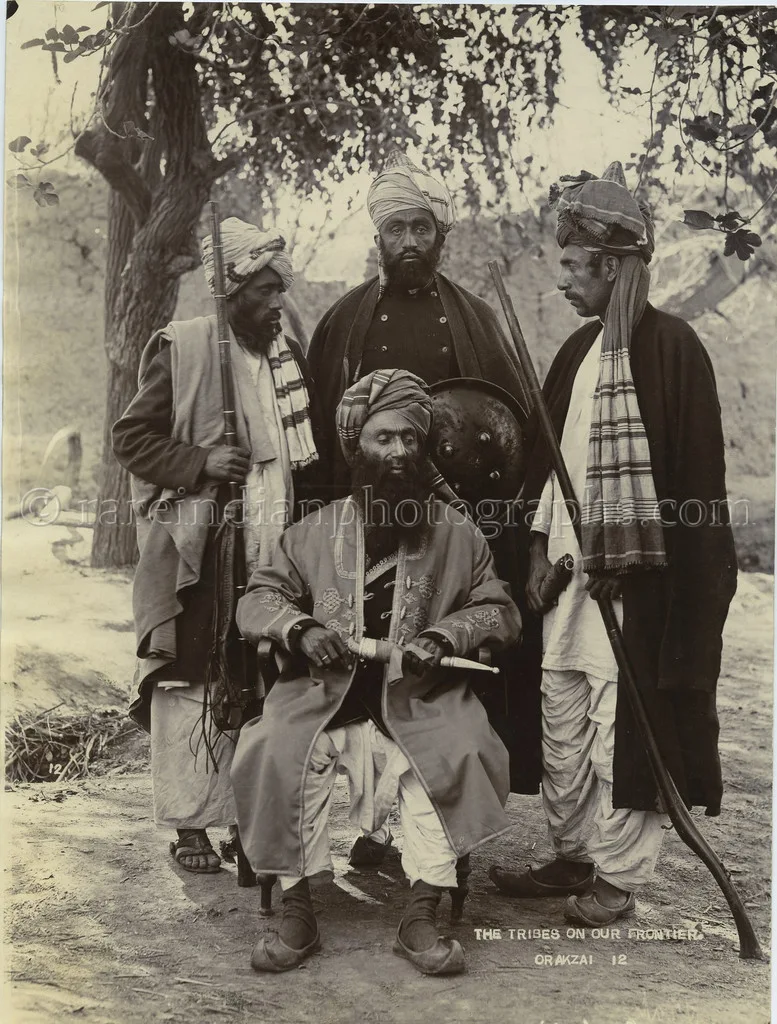
Group portrait of an Orakzai Chief and three tribesmen, ca. 1900, , the Chief sits in an armchair wearing a striped turban, an embroidered woolen full-length embroidered coat over a velvet gold-embroidered waistcoat, he wears baggy Pathan pants and traditional leather shoes with curling toes, he carries a Khyber knife in its scabbard with metal locket and chape, the three tribesmen around him are armed with jezail matchlocks, Khyber knife and a metal shield dhal with 4 bosses. This image was published by the Arts Photo Works of India as `Our restless neighbours the Pathans’
Inhabitants of Khyber : Shinwari , Afridi and Orakzai, 1827-1843. By Imam Bakhsh Lahori.
In the early 18th century, an aged Pashtun chieftain, Jalal Khan Orakzai, along with his sons, followers, and dependents, heroically saved thousands of Muslims in India from a genocidal maniac.
That genocidal maniac was Banda Singh Bairagi, the savage successor of Guru Gobind Singh. Maddened by anti-Muslim rage, Banda Singh completely destroyed Sirhind city in 1709 and sacked a vast territory of East Punjab with unprecedented barbarity in India. He knew no limits when committing atrocities; he and his followers even ripped open the bellies of pregnant women and brutally killed suckling babes. The author of "Siar-ul-Mutakhireen" writes:
"He (Guru Gobind) was succeeded by Banda, that butcher-like man. This infernal man having assembled multitudes of desperate fellows, all as enthusiasts, and all as thirsty of revenge as himself, commenced ravaging the country with such a barbarity as had never had an example in India. They spared no Mohammedan, whether man or woman or child. Pregnant women had their bellies ripped open, and their children dashed against their faces or against the walls." It is no wonder that the mild Bahadur Shah shuddered on hearing of such atrocious deeds.
Capitalizing on Mughal Emperor Bahadur Shah's preoccupation in the Deccan, Banda Singh occupied a vast territory of East Punjab, leaving behind a trail of death and destruction. Emboldened by his successes, Banda Singh marched upon Saharanpur (Western U.P.) with a large body of his followers. An aged Pashtun zamindar named Jalal Khan Orakzai possessed certain villages in the pargana of Thana Bhawan in Saharanpur, where he built a mud fort with a small town inside it, named Jalalabad after himself. His father, Hazar Mir Orakzai of Miranzai Khel, had come to India during the reign of Emperor Shah Jahan. While others fled in terror at the news of Banda Singh's approaching horde, Jalal Khan and his Pashtuns remained unflinched, deciding to face the Sikhs head-on. Despite having only a small lashkar at his disposal, he stoutly defended his town of Jalalabad and routed the Sikhs with such tenacity that they abandoned any further advance into modern-day Uttar Pradesh, retreating instead to Punjab. Thus, his brave resistance saved the lives of tens of thousands of Muslims. The contemporary historian Mirza Muhammad summarizes the achievements of Jalal Khan Orakzai in his Ibratnama [written in 1719] as follows:
"The Sikhs in the (Ganga-Yamuna) Doab who after the capture of Saharanpur, entertained the ambition of conquering that entire territory, suffered much punishment from the swords of the sons and relatives of Jalal Khan Ruhela, the master of Jalalabad, 7 kurohs from Deoband. Thereafter, contenting themselves with they had already obtained in the Doab, they turned back from there." [English translation by Iqbal Hussain]
The following account of the war between Jalal Khan Orakzai and Banda Singh's Sikhs is largely drawn from William Irvine's 'Later Mughals,' which is based on contemporary Persian sources. When the Sikhs crossed the Yamuna River and entered Saharanpur territory, the city's faujdar, Ali Hamid Khan Qannauji, a Hindustani Muslim, was seized by fear. That night, he and his soldiers abandoned Saharanpur and fled to Delhi, leaving its people defenseless. Learning that the imperial officer had deserted the town, the Sikhs hastened to the spot. They soon overcame the inhabitants' resistance and subjected the city to the same atrocities they had committed in Sirhind. The entire country, far and near, was in a panic. People, rich and poor alike, began to flee the region. In this way, half of the Saharanpur sarkar fell into the hands of the Sikhs.
Earlier, the only defeat Banda Singh's followers had suffered in Punjab was at the hands of Shams Khan, a Kheshgi Afghan of Kasur. Consequently, they were naturally hesitant to attack the town of Jalalabad, an Afghan colony within the Saharanpur sarkar. Jalalabad, founded by Jalal Khan, was surrounded by mud walls. It lies approximately thirty miles south of Saharanpur and about twenty miles west of Deoband.
The Sikhs sent messengers to Jalal Khan Orakzai, calling upon him to submit. However, the proud Afghan was unfazed by the recent Sikh successes. When the Sikh messengers appeared before him, Jalal Khan Orakzai ordered them to be paraded derisively through the streets and then expelled from the town. Immediate preparations were subsequently made for the defense of the small town of Jalalabad.
Soon, Jalal Khan received word that the Sikhs had surrounded two villages, both dependent on Jalalabad and located four or five miles away. He immediately dispatched a force, led by his grandson Ghulam Muhammad Khan and cousin Hizbar Khan, to relieve these villages. Encouraged by the reinforcements, four or five hundred villagers, armed with matchlocks or bows, along with many of their tenantry, who were variously armed (many with only slings and stones), boldly emerged to disperse the Sikhs. In the ensuing fight, Hizbar Khan and a number of Afghans and villagers lost their lives. Ultimately, however, pressed by repeated Afghan onslaughts, the Sikhs retreated.
Other contests followed between the Sikhs and Jalal Khan, and the former were repulsed two or three times. In spite of these reverses, the Sikhs persisted in their attempts against the town. Banda Singh had brought seventy to eighty thousand men from all parts to capture Jalalabad. The Sikh assailants prepared two to three hundred movable batteries, formed of planks and mounted on cartwheels. Jalalabad was closely invested. When these batteries were brought to the foot of the walls and close to the town gate, the Sikhs showered bullets, arrows, and stones upon the Afghans from them. Then, with cries of "Fateh Darshan," four or five hundred Sikh men, carrying mattocks and other tools, rushed forward, intending to dig through the earthen wall, to affix ladders, and to set fire to the gates. At such moments, the Afghans threw open the gates and, sword in hand, with their shields raised before their faces, made a rush upon the foe. In each sally, they cut down two or three hundred of the Sikhs, at the same time losing many lives on their own side. At night, other sallies were made, catching the besiegers unawares and putting them to the sword. For twenty days, the besieged found no proper leisure to eat or rest. In the end, after losing some thousands of men, the Sikhs withdrew without having been able to take the town. [Ref: 'Later Mughals', Volume-I, pp-101-102]
The clashes between Afghans, led by Jalal Khan, and Sikhs, led by Banda Singh, spanned from June to October 1710. Numerous encounters between the two forces are recorded in 'Akhbar-i-Darbar-i-Muala' (The Mughal News-letters). Jalal Khan became a punishing sword against the Sikhs. Even after the Battle of Jalalabad, Jalal Khan continued to pursue and relentlessly attack the Sikhs.
For the victory over the Sikhs, Jalal Khan was rewarded by the Nazim of Delhi, on 31st August 1710 AD, with the Faujdari of Saharanpur deserted by Ali Hamid Khan Qanauji. He was raised to the rank of two thousand and five hundred in the reign of Jahandar Shah, with a further promotion during Farrukh Siyar's time. He died in September 1718 AD. [Ref: Ibrat-Namah by Muhammad Harisi, 82b]
Orakzai tribesmen on their way to fight in Kashmir, 13th November, 1947. Photo by Frank LeesonA group of Akali Sikhs on the march
In the latter part of the sixteenth century, Bayazid Ansari alias Pir-i-Roshan made Tirah his stronghold. The Roshniyas lived among the Orakzai, partly with the Ismailzai and Lashkarzai and partly in the Mastura valley with the Daulatzai. Orakzais fought on the side of Jalala (son of Pir Roshan) against the Mughals. Jalala was succeeded by his nephew and son-in-law, Ihdad. He further consolidated his position amongst the tribes of Tirah particularly amongst the Orakzai. By then Emperor Akbar had been succeeded by Emperor Jahangir. The latter sent Mahabat Khan (the Subedar of Kabul) to Tirah in 1618 A.D to crush the tribal support to Ihdad in Tirah. Mahabat Khan connived with the Bangash Khans of Hangu against the Orakzai chief, Asghar Daulatzai. The Banagsh 'Khan' invited some of the Orakzai notables, including Malik Asghar and his sons, the zealous followers of Ihdad, under the pretext of awarding them 'khilats'. All of them (about 300), except Malik Asghar and his cousin Tor, were massacred. When the neighboring tribes questioned the conduct of the involved Bangash 'Khans', they pleaded that by doing so they wanted to break the strength of Ihadad who made Tirah his stronghold and brought misery to the area. After this act of treachery by the Bangashes of Hangu, Malik Asghar gave up the chieftainship of the Orakzai tribe to his cousin, Malik Tor of Abdul Aziz Khel clan. Realizing this massacre as a preamble for the main invasion by the Mughals, the Daulatzai under Malik Tor and other Roshnais under Ihadad, occupied the crest of the pass.
As expected by Malik Tor, Ghairat Khan, the Mughal commander, along with twenty-two other Mughal leaders, led a large force via Kohat against the Orakzai. They took up position in the vicinity of the Ismailzai clan at the foot of the Loe Sang-Pajzah Ghashaey or Great Sang-Pajzah pass. Ghairat Khan was a hot-headed and self-opinionated person. He did not accept his deputy, Jalal Khan's prudent advice and attacked the Orakzai forthwith. Accompanied by some of the Syeds of barha, he climbed the hill to attack the "sangar" held by the Daulatzai clan. On reaching the crest of the pass, the Pashtuns of Tirah, collecting from different recesses of the hills and kotals, completely surrounded the attacking force. In this melee, the Orakzai hamstrung the horse of Ghairat Khan and got him dismounted. Ghairat Khan was confronted by Panju, a Firoz Khel Orakzai, who grappled him and both fell, rolling over the other. Panju cried out to his clansmen, "Strike ! Kill me along with him, only do not let him escape!" And they did so; both Ghairat Khan and Panju were killed, locked firmly in each other's embrace. This killing of Ghairat Khan brought about the defeat of the Mughals. Jalal Khan Gakhar, Masud, son of Ahmad Baig Khan, Bejzan, son of Nad Ali, the Maidani and other imperial chiefs, fearing for their lives and unable to stand their ground, fled helter-skelter. The Orakzai, crowing different parts of the Kotal above, pelted them with stones and arrows, surrounded and slew the imperial troops in great numbers. Among the slain were Jalal Khan and Masud. The Orakzai captured about 5,000 horses, which reflects the extent of the disaster that the Mughals suffered.
Mahabat Khan, hearing of this disaster, dispatched a fresh force to the aid of the remnants of the defeated troops and further strengthened the Mughal posts in the area. Khushal Khan says, "The Mughals could affect nothing, and Mahabat was recalled ".
Tirah, 1898
Books consulted
1- "Notes on Afghanistan and Balochistan" by H.G.Raverty
2- "History of the Pathans", Vol-4, by Haroon Rashid
3- "Tuzk-i-Jehangiri "
4- Imperial Gazetteer2 of India, Volume 23
The Tirahis are a Dardic people who once populated the whole mountain country of Tirah and were driven out of that country by the Pir-i-Roshan in 16th century. At the present day the chief seat of the Tirahi is in the Kotrud—"Castle river "—valley of the Shinwari country in Nangrahar, or Jalalabad district.. In the Nazyan valley (Kotrud) the Tirahi were reckoned at two thousand families in 1891. ("An Inquiry Into the Ethnography of Afghanistan by H.W.Bellew, p-95)
Major H.G.Raverty incorrectly referred to them as Tajiks. Their language has been studied by the linguists and it is a Dardic language ( Reference: "Notes on Tirahi" by Georg Morgenstierne). The Tirahi language is on the verge of extinction (or has been recently extinct according to some reports). Pashayi people of eastern Afghanistan are also Dards. The Tirahis called their ruling class by the appellation of 'sultan'.
According to Hayat-i-Afghani ;
"Tirahis were notable people in 12th century A.D and completely dominated the country of Tirah . They were idol-worshipers and were fierce enemies of Muslims. In 1204 A.D, Shahabuddin of Ghor, invaded their country and killed large numbers of them. The remnants were forcibly converted to Islam. Nowadays small numbers of them, Muslims, live in the country of Shinwaris. They speak a distinct language, probably derived from Sanskrit, but has many Pashto words in it". (page-470)
Orakzais narrate a legend that their progenitor Sikander Shah, a Persian prince, married a Tirahi woman and permanently settled in Tirah about 1000 years ago. (A Glossary of the Tribes and Castes of the Punjab and North-West ..., Volume 3, page-176). Tirahis to this day are found in some villages as 'hamsayas' of the conquering Orakzais.
In 1519 Sultan Bayazid of Tirah attempted to convince Babur Badshah to attack the Afridi Afghans, who were camped at Bara with their flocks. Babur in his diary says ;
"Today arrived Sultan Bayazid, who came up by the Bara-road after hearing of us ; he set forth that the Afridi Afghans were seated in Bara with their goods and families and that they had grown a mass of corn which was still standing. Our plan being for the Yousafzai Afghans of Hash-naghar, we paid him no attention. At the mid-day prayer there was a wine party in Khwaja Muhammad Ali's tent . During the party details about our coming in this direction were written and sent off by the hands of a sultan of Tirah to Khwaja Kalan in Bajaur ". ("Baburnama", Eng.trans by A.S.Beveridge, p-411)
Munim Beg (Mughal general) plundered Tirah shortly before Humayun Badshah's invasion of India in 1555. According to "Tazkira-Humayun o Akbar" of Bayzid Bayat (the author was in Humayun's service), Munim Beg attacked Tirah on the pretext that its chieftain Fateh Shah was a "Chiragh-Kush" heretic (p-152).
The Tirahis were attracted to the teachings of Bayazid Ansari, as were the Afridis and Orakzis. The Tirahis had been seeking the aid of Mughals in order to keep the Afghans from snatching the land of Tirah from them which angered Bayazid Ansari. The latter conspired with the Afridis and Orakzis to dispossess the Tirahis of their own country. The Tirahis got wind of an Afghan plot and armed themselves. Bayazid upbraided them for arming themselves and taking shelter in their fortresses. He commanded them to repent and come before him with their hands bound behind their backs. Three hundred twenty of them did so and were immediately put to death. The Afghans then plundered Tirah, and those Tirahis who remained alive fled to Nangarhar. The Afridis and Orakzis then settled Tirah. (" Thetransformation of Afghan tribal society", Joseph Theodore Arlinghaus, pp.302-303)
Khushal Khan Khattak refers to Tirahis in his poetry as follow ;
On October 22, 1947, Pashtun tribesmen entered Kashmir from Pakistan, in response to the mass killing of Muslims in Jammu and in support of insurgents of Poonch, with logistical support from the Government of Pakistan. On October 24, the insurgents in Poonch formally declared independence as the state of Azad Kashmir.
Orakzai tribesmen on their way to fight in Kashmir, 13th November, 1947. Photo by Frank Leeson.
Tribal irregulars from the North West Frontier bound for Kashmir, 1947. From an album, collated and annotated by Lt Frank Leeson, relates to his service during 1946-1947 with the North Waziristan Khassadars, a force of tribal police engaged in protecting communications and military outposts in the Tribal Territory.. [Source: National Army Museum, London]
A Brigadier of Pakistan army distributing arms to tribal fighters during the Kashmir conflict of 1948. Source
Late Senator Malik Gulab Khan Mahsud (Sub tribe Ishangi) was chief of Behlolzai tribe. He participated in Kashmir war of 1948 and received Hilal-i-Kashmir and Tamgha-i-Kashmir for his role in that war. Source
In this report published in BBC, Hussain Gul, then a soldier of Paramilitary Kurram Militia, shares his experiences of that war:-
"Hussain Gul, a resident of Shalozan village in the Kurram tribal region who was then a soldier of the paramilitary Kurram Militia, was part of that force.
"We were there to attack and recapture [the 2,800-metre] Pandu ridge which the Indians had occupied during autumn," he says.
"It was a good victory. We were able to occupy a considerable part of Kashmir but we still lost most of it. It made one feel sad, like when you lose a part of your house,"
His father, who went in with a band of friends to fight during the previous season, "came back defeated".
"They brought back war booty though; gold and some women," he chuckles.
In his mid-90s now, and with a fading memory, he is not sure what happened to the women. As for gold, "they were cheated out of it by Majoor", an ethnic Hazara businessman in Parachinar, the central town of Kurram.
The picture on Hussain Gul's Kurram militia's ID
Kazi Abdul Sarir (Abakhail) from South Waziristan (Makin) brought 28 fighters to the 1947-48 war of Kashmir. He received the title of Sher-i-Kashmir from the Government of Pakistan and a certificate from the Government of Azad Kashmir acknowledging his services. The certificate says he and his men fought well in the battle at Naushera (Kashmir).
Sanad issued by the government of Azad Kashmir to Khalifa Sultan Jan Niazi (Mirali Khel), son of Mullah Nazeem, of Dera Ismail Khan, acknowledging his services in the 1947-48 war of Kashmir. He brought 190 fighters to the war. Photos of his sons.
A sanad issued by the Government of Azad Kashmir acknowledging the services of Karimullah in 1947-48 War of Kashmir. He was the commander of a force, known as Jamat-i-Naajia, assembled by Haji Muhammad Amin of Umarzai, Charsadda district.
Risaldar Major Ghulam Rasul Niazi of 15th Lancers of British-Indian army participated in the Kashmir war of 1948 and earned the title of Ghazi-i-Kashmir. ["History of the Pathans", Vol-III, p-383]
A reproduced copy of sanad issued by the government of Azad Kashmir to Khalifa Sultan Jan Niazi, son of Mullah Nazeem, of Dera Ismail Khan, acknowledging his services in the 1947-48 war of Kashmir. He brought 190 fighters to the war. [published in "Tarikh i Niazi Qabial" by Iqbal Khan Niazi]
Armed Mohmand tribesmen waiting on the road between Peshawar and Rawalpindi for their leader Bacha Gul [son of Haji Sahib of Turangzai] to arrive with trucks and extra ammo, to lead them into battle in Kashmir, December 1947. Photograph by Margaret Bourke-White.


.jpg)