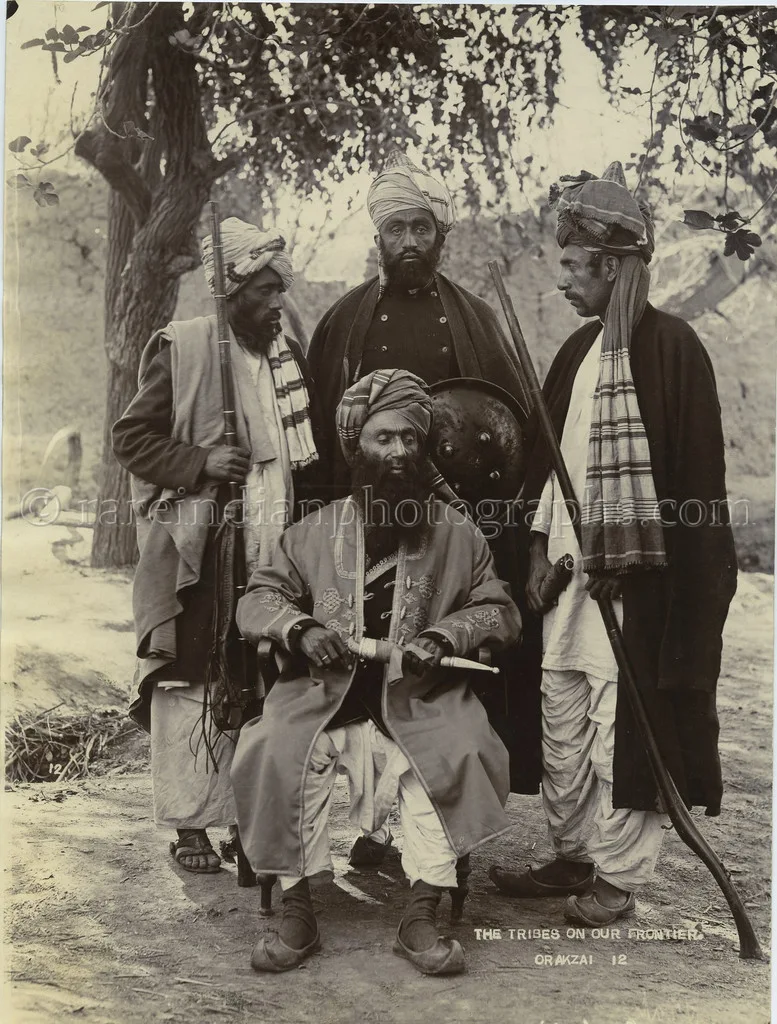
Origin legend
According to the legends prevalent amongst the Orakzai elders, Tirah was formerly occupied by the Hindu non-Pashtun race, called the Tirahis whose descendants are, to this day, found in some villages as 'Hamsaya' (dependents) of the Orakzai. Tirahis were ruled by different rajas whose names can still be traced in several places in Tirah such as the Rajgal valley, Darbar Ghundi and Moula Ghar, named after King Rajgal, Raja Darbar and Raja Moula respectively.
White King conjectures that about 1,000 years ago, a Persian Prince, Sikandar Shah, captured the Tirah region, and he is considered by some as the ancestor of the Orakzai tribe. As the legend goes, Prince Sikandar, in his own country used to amuse himself by breaking the pitchers carried by the women drawing water from the springs near his palace in Isphahan, a hobby of majority of the princes of old legends. The people complained to the king about the prince's leisure-sport who chided the prince, but to no avail. The prince continued his sport and one fine morning he, to his dismay, found that his shoes had been turned upside down, meaning thereby his expulsion from the kingdom. He was henceforth known as the, 'Wrukza', that in Pashto means 'get lost or be exiled'. The prince left his country and came to Urghan in the Waziristan territory, the capital of the Muhammadan King of Kohat, who gave him employment at his court. After sometimes, the Persian King repented his action and sent a court musician (Dum) named Banga to bring back the exiled prince. Banga had been the prince's friend since childhood. In course of time, Banga found his way to Kohat where Sikandar Shah welcomed him, called him his brother and gave him a seat next to him in the royal durbar. From Banga, the King at Kohat learned that Sikandar Shah was exiled son of the King of Persia. The King married to him one of his daughters. At about that time, the Tirahis started raids on the suburbs of Kohat; consequently, the King of Kohat sent Prince Sikandar Shah to subdue the Tirahis. He set out by the Tora Pakha route and reached Tanda in the Mastura valley. He defeated the Tirahis and drove them into the Maidan of Tirah and thereafter across the mountains of Nangarhar where their descendants are still said to be settled. In the meantime, the King of Kohat died and Banga established himself as the new King of Kohat. Sikandar Shah fought Banga's forces at Muhammadzai, near Kohat and was defeated. So, Sikandar Shah was obliged to settle down in Tirah where he established himself and married a Tirahi woman as his second wife. From Banga originated the Bangash tribe of Kohat. Sikandar's descendants were called by their neighbors as the sons of 'Wrukza' which got corrupted into Wrukzai or Orakzai.
(Reference: "History of the Pathans" by Haroon Rashid, Vol-IV, p-52)
Conflict with the Mughals
In 1619 or 1620, Mahabat Khan, Subahdar of Kabul, under the emperor Jahangir, treacherously massacred 300 Daulatzai Orakzai, who were Roshania adherents; and, during his absence on a visit to Jahangir at Rohtas, Ghairat Khan was sent with a large force via Kohat to invade Tirah. He advanced to the foot of the Sampagha pass, which was held by the Roshanias under Ihdad and the Daulatzai under Malik Tor. The Rajputs attacked the former and the latter were assailed by Ghairat Khan's own troops, but the Mughal forces were repulsed with great loss. Six years later, however, Muzaffar Khan, son of Khwaja Abdul Hasan, then Subahdar of Kabul, marched against Ihdad by the Sugawand pass and Gardez, and after five- or six-months' fighting Ihdad was shot, and his head sent to Jahangir. His followers then took refuge in the Lowaghar; and subsequently Abdul Kadir, Ihdad's son, and his widow Alai, returned to Tirah. The death of Jahangir in 1627 was the signal for a general rising of the Afghans against the Mughal domination. Muzaffar Khan was attacked on his way from Peshawar to Kabul, and severely handled by the Orakzai and Afridis, while Abdul Kadir attacked Peshawar, plundered the city, and invested the citadel. Abdul Kadir was, however, compelled by the jealousy of the Afghans to abandon the siege and retire to Tirah, whence he was induced to come into Peshawar. There he died in 1635. The Mughals sent a fresh expedition against his followers in Tirah; and Yusuf, the Afridi, and Asar Mir, the Orakzai chief, were at length induced to submit, and received lands at Panipat near Delhi. Simultaneously operations were undertaken in Kurram. Yet, in spite of these measures, Mir Yakut, the imperial Diwan at Peshawar, was sent to Tirah in 1658 to repress an Orakzai and Afridi revolt.
(Reference: Imperial Gazetteer of India, Provincial series: North-West-Frontier", page-235)
Orakzai notables in India, Dost Muhammad Khan and Jalal Khan
Dost Muhammad Khan, born in 1672 A.D, was the son of Nur Muhammad Khan, and belonged to Mirazi Khel clan of Orakzais of Tirah. He emigrated to Hindustan, somewhere between 1697 and 1703, during the final years of Emperor Aurangzeb Alamgir. He founded the Bhopal principality in 1707 and expanded it till his death in 1728. At its zenith, the Bhopal state comprised a territory of around 7,000 square miles (18,000 km2). The state became a British protectorate in 1818 and was ruled by the descendants of Dost Mohammad Khan till 1949, when it was merged with the Dominion of India.
Jalal Khan 's father, Hazar Mir Orakzai of Miranzai Khel, came to India during the reign of Emperor Shah Jahan and obtained the zamindari of certain villages in the Jamuna-Gangetic Doab. After his father's death, Jalal Khan succeeded to the zamindari and obtained, in addition thereto, some more villages in the pargana of Thana Bhawan, near which he built a fortress and founded the town of Jalalabad (Saharanpur, U.P). In 1709 Jalal Khan faced seventy or eighty thousand Sikhs of Banda Singh and successfully defended his fort with just few hundred men. For the victory over the Sikhs, Jalal Khan was rewarded by the Nazim of Delhi, on 31st August 1710 AD, with the Faujdari of Saharanpur. He was raised to the rank of two thousand and five hundred in the reign of Jahandar Shah, with a further promotion during Farrukh Siyar's time. He died in September 1718 AD.
Orakzais during the Durrani period
Since the decay of the Mughal empire, Orakzai tribes had been virtually independent, though owning at times a nominal allegiance to Kabul. Syed Ghulam Muhammad in Timur Shah's reign, has following description of Orakzais;
"The Afghan tribe (Orakzai) contains some thousands of families, and they dwell in mountain tracts of Tirah, the Khyber, and Jalalabad. They have to furnish a contingent of soldiers to the Badhshah of Kabul, and their Sardars hold jagirs or fiefs in the Peshawar district for guarding and keeping open the passes within their boundaries." (Reference: Raverty, "Notes on Afghanistan", p-95)
During the Durrani period, the titular chief of the Orakzai belonged to the Abdul Aziz Khel clan. He had very cordial relations with the Saddozai Kings at Kabul. The Abdul Aziz Khel 'Khan Khels' had a 'sanad' from Ahmad Shah Abdali , granting them a 'jagir' and some monetary allowances. In 1796-7 AD, Orakzais provided an infantry contingent of ten thousand men to Zaman Shah for his invasion of the Punjab. The Durranis, from the very beginning , managed the Orakzai tribe through the Bangash 'Khans' of Hangu. During the Barakzai and Sikh domination of the area, the Orakzai were under the management of Sultan Muhammad Khan Barakzai, the governor of Kohat. (Reference: "History of the Pathans" by Haroon Rashid, Vol-IV, p-70)