Painting depicting intense hand-to-hand combat between a party of Mahsud tribesmen and the Gurkha mercenaries of British-Indian army at Ahnai Tangi, South Waziristan, 14 January 1920. On this say, the British admitted to the loss of 15 officers and 450 soldiers in fighting in and around Ahnai Tangi. Pashtun tribesmen suffered lesser casualties, estimated by British to be 250 Mahsuds and 70 Wazirs killed.
This blog by Barmazid features articles on the history of the Pashtun people as well as images of historical importance related to Pakhtunkhwa and its people
Saturday, 29 December 2018
Hand-to-hand combat between Mahsud tribesmen and the Gurkha mercenaries of British-Indian army [14 January 1920]
Painting depicting intense hand-to-hand combat between a party of Mahsud tribesmen and the Gurkha mercenaries of British-Indian army at Ahnai Tangi, South Waziristan, 14 January 1920. On this say, the British admitted to the loss of 15 officers and 450 soldiers in fighting in and around Ahnai Tangi. Pashtun tribesmen suffered lesser casualties, estimated by British to be 250 Mahsuds and 70 Wazirs killed.
Zaimusht tribe (Tor Tarin)
The Zaimusht or Zaimukhts are a tribe of Tor Tarin Afghans who inhabit the hills between the Kurram and the Orakzai border on the north-west frontier of Kohat. The tradition among the Bangash is that they were fugitive slaves of the Tarins, and were given the country they now occupy, by them. The tribe lives on the southern slope of the Zawa Ghar Range, having for their neighbours, on the north-west the Turis, on the north and east the Orakzais, and on the south and south-west the Bangash.
Wednesday, 26 December 2018
Response to Salman Rashid, a travel writer and a pseudo-historian
Salman Rashid, a travel-writer from Lahore, refers to Pashtuns as idiots after reading few emails from some Pashtuns in which he was told that Yousafzais moved into Swat and Mardan in 16th century and that they are not ancient inhabitants of those parts. He remarks, "The mind boggles at the idiocy of a nation brought up on manufactured history". Interestingly its him who is making fool of himself here. He should try reading Akbarnama of Abu Fazal written around 1585. Abdu Fazal was courtier of Mughal emperor Akbar and Akbarnama is an official history authored by him. Abu Fazal writes,
"This large tribe (Yousafzai) formerly lived in Qandahar and Qarabagh. From there they came to Kabul and became powerful. Mirza Ulugh Beg Kabuli massacred them by a stratagem. Those who remained took refuge in Lamghanat. Afterwards they settled at Hashtnagar. It is nearly one hundred years since they settled in Swad (Swat) and Bajaur" [Akbarnama, English translation by H.Beveridge, Vol-III, p-716].
Monday, 24 December 2018
Bairam Khan and Sher Shah Sur
Sher Shah Sur appear as a pathetic villain in an Indian TV series which is about life of Mughal emperor Akbar. This scene in which Bairam Khan (a general of Humayun and Akbar) embarrasses Sher Shah, is fictional and is not recorded in history. According to Tarikh-i-Shershahi, Sher Shah had to spare the life of Bairam Khan because he had taken refuge in the house of an Afghan and was protected in accordance with Pashtunwali. The Afghan who provided him asylum in his house was Isa Khan Sarwani. Bairam Khan was eternally grateful to him. Later when Mughal came back to power and Afghans were on the run, Bairam Khan once remarked about Isa Khan Sarwani, "He saved my life; if he will come to me, i shall feel myself honoured. If i cannot give him more than Sher Shah , I at least will give him his own Sambhal ". When 90-years old Isa Khan was informed of this, he rejected the offer. He considered it beneath his dignity to obtain help from a Mughal.
Thursday, 20 December 2018
Dehgans of Afghanistan
Dehgans (دیگان) are Dardic ethno-linguistic group of Afghanistan settled in the Kunar valley, and scattered also over the districts of Nangarhar and Laghman. In Nangarhar Dehgans are found principally in Pesh Bolak, Kandibagh, Hisarshahi, Deh -i-Tahir, Lawangapur, and Mast Ali, but the present home of the race is Kunar and in the Dara-i-Nur and some parts of Laghman. They seem once to have been spread over most of the north-east of Afghanistan.
Friday, 14 December 2018
Mehr Dil Khattak, a Khalifa of Faqir of Ipi
Photo of Mehrdil Khan Khattak, a principal Khalifa (lieutenant) of Faqir of Ipi. The boy sitting at front was named by Quid-e-Azam , according to the caption on the photo.
Mehr Dil Khattak was an ex-Tochi Scout havildar. His greatest raiding achievement was an attack on Bannu City on the night of 23-24 July 1938. Khalifa Mehr Dil Khattak, surrendered to Pakistani officials in Bannu [November 1954] along with seventy followers.
Wednesday, 12 December 2018
Tani tribe
Tanis are descendants of Tanaey son of Shitak by his second wife. The Jadrans, their neighbors, consider them as the descendants of Kagh, a servant of Shaikh Beitan. Nevertheless, they are accounted amongst the Karlanris. They are spirited and brave and have a sense of Afghan honour.
It is said that Tanaey had two sons, Ari from whom are descended the Aryuzai ; and from the second son, Mari, descended the Mari Khels. Mari had adopted also an infant child named Sinkaey whose descendants are accordingly called Sinkaey. This clan is chiefly located at the bases of the hills in the southwest corner of Khost. Dargai is their chief village in the plain. Their other settlements are Hasarak, Gokha, Narkhai and Uthman, all in Afghanistan.
Some of the Tanis had accompanied the Pannis and Naghars to Hind. Subsequently, the Naghars and Pannis made themselves conspicuous in joining the mercenary armies of the local rajas and carved out petty khanates for themselves, however, the Tanis remained obscure. They used to do petty chores for Naghar 'khans' and remained attached to them. They were referred to by the name of ' Beit ', probably in allusion to their descent from Shaikh Beitan, however, this supposition cannot stand the commonly accepted version of their Karlanri descent.
Being an inconspicuous tribe and living away from the border the clan as a whole did not appear in the history of the area. ["History of the Pathans" by Haroon Rashid, Vol-5, pp.434-435]
In 1867, Muhammad Hayat Khan gives following description of the Tani tribe;
"Tani clan is sedentary and lives in regularly constructed houses......The men are of tall and of a warm, fresh complexion. Their food mostly consist of wheat, barley and millet, with the flour of which is commonly ground up a kind of dried chestnut called Shah balut or, in Pashto "pargai". In dress they mostly resemble Dawari, though some wear a long woolen garment and twisted pyjamas of stripped cotton, and like them, are excessively filthy and disgusting in their persons. They are, indeed, no less licentious, but have more sense of Afghan honour than the Dawari. The land, the cultivation of which furnishes the occupation of most of them, is mainly dependent upon the rain. Some few trade in brass to Bannu, but like the Dawari, the men of this clan are little given to straying from home. Those in hills have large flocks of goats, and in the plains of sheep, while cattle are also numerous amongst them. This clan belongs to the White faction of Khost, and have bitter enmity with the Ismailkhel and other clans of Black faction, against whom their courage more than supplies any deficiency of arms. Probably not more than one-fourth of their men have firearms, the rest having sword and shield only. Though fairly at accord among themselves, they are not quite free from internal discords. The whole clan is divided into two factions, to one of which the Sinaki and Aryuzai belong, to the other and more numerous, the Marikhel, of which the most numerous section is Utikhel. The Marikhel is also split into two hostile factions, called the Darinama and the Khaibikhel. At present, the first named section has for maliks, Gul Khan and Gul Haibat, the latter Ismail and Aldagal. Other maliks of the Marikhel are Khan Fakir. Sher Ahmed, Dalwaz etc. As they are partly located in the plain, the Tani are claimed to be subject to the governor of Khost, and are nominally charged with a tribute of Rs.1,000 a year. Of this, however, Rs.200 is returned to the maliks, while the remainder is chiefly taken out in horseshoes and other articles of iron, largely manufactured in the country, and specially in Gokha. Notwithstanding the consideration thus shown them, the Tani occasionally become restive and refuse to acknowledge the authority of the governor. " [Hayat-i-Afghani]
![]() |
| Add captionMalak Kattay Tani of Khost. Picture taken by Alan E. Farstrup on 15.11.66 at Mir Ali. From Archives of Senator Faridullah Khan Shaheed. |
Tuesday, 4 December 2018
Sunday, 2 December 2018
Friday, 23 November 2018
Wednesday, 21 November 2018
Friday, 16 November 2018
Wednesday, 14 November 2018
Fruit shops in Kabul, 1840
![]() |
| The Main Street in the Bazaar at Kabul in the Fruit Season', c.1840 . By James Atkinson. |
"I paid my first visit to the city this afternoon. The path was crowded with people, and after a pretty long ride we entered, not by a gate, as usual, but by a narrow street, which is the introduction to Caubul. There we were, indeed, astonished by the luxurious appearance of the fruit shops. Melons, grapes, pears, apples, plums, peaches, in wonderful profusion, and all ranged in beautiful order on pieces of masonry, of different heights, so as to exhibit them in the most attractive way.” The shops themselves are little better than sheds. It is not only the beauty of the fruit, but its prodigious abundance, which strikes the mind so forcibly. We do not see half a dozen melons, or a dozen bunches of grapes, but thousands. This display continued a great distance, the shops twin-brothers all, but still delightful. Caubul has always been famous for its fruit. The Emperor Baber says in his Memoirs, “The fruits of the cold districts in Caubul are grapes, pomegranates, apricots, peaches, pears, apples, quinces, jujubes, damsons, almonds, and walnuts, all of which are found in great abundance. I caused the sour cherry-tree, the aloobala, to be brought here and planted; it produced excellent fruit and continues thriving. The fruits it possesses, peculiar to a warm climate, are the orange, citron, the amlook (a berry like the karinda), and sugar-cane, which are brought from Lamghanat, now called Laghman. I caused the sugar-cane to be brought, and planted it here; they bring the julghuzak (the seed of a kind of pine of a large size) from Nijrow; they have numbers of bee-hives, but honey is brought only from the hill-country on the west. The rawāsh of Caubul’ (rhubarb, tarts made of it have precisely the taste of gooseberries) “is of excellent quality; its quinces and damask plums are also excellent, as well as its bâdrengs, a large green fruit, somewhat like a citron.” He also says, that, “on his return from the conquest of Lahore, he brought plantains and planted them, and that they grew and thrived,” but I have not seen one in this country. As we moved along, other articles for sale were presented to view in succession. Cooks were preparing kabobs, and confectioners, sweetmeats. Cutlers and farriers employed on guns, swords, and horse-shoes; the silk mercer, the dealer in carpets, furs, lace, chintz, saddlery, &c., all attentive to their occupations, and all in the open day. The vegetables as well as the fruit are of an excellent kind; and the mutton sold in common to the inhabitants is much superior to any I ever saw in an Indian bazaar.
Every joint was a picture for painters to study,Doomba mutton, however, though it looks so well, is not sufficiently delicate for European taste. It has a strong flavour. Nothing could exceed the industry that appeared everywhere around us ; everybody employed and intent upon his calling" ["The Expedition Into Afghanistan", By James Atkinson, p-271]
The fat was so white, and the lean was so ruddy.
Sunday, 11 November 2018
Afghan nomads (Kochi or Pawanda)
"Powandah is the name given to the nomad tribes of Afghans who move about with their flocks and herds, and act as carriers between their own country and India" (Raverty, "A Dictionary of the Puk'hto, Pus'hto, Or, Language of the Afghans, p-1106)
📖 Related Posts
Tuesday, 6 November 2018
Old Kandahar
Occupying the base of a bare rocky hill, about 3 miles to the west of modern Kandahar, are the ruins of the ancient city "Shahr -i- Husain Shah" after its last king, Shah Hussain Hotak. The remains of its former extensive defences crown the height of the rock, and were supplied with water from adjacent reservoirs partially cut out of rock, and partially built up. It is said to have been founded by Alexander the Great, and to have been several times destroyed and rebuilt by its Arab, Persian, Tartar, Turkman, and Uzbak conquerors, and was finally taken by surprise and sacked and destroyed by Nadir Shah, about 1738 A.D. The population of the city was resettled in Nadirabad, a new city built by Nadir on the site of his camp about 2 miles southeast in the open plain. This was hardly built before it was destroyed by Nadir Shah's successor in Afghanistan, Ahmad Shah Abdali, who founded the present city in 1747, and called it Ahmad Shahr or Ahmad Shahi.
The ruins of the old city are very extensive, and without apparent diminution have been delved for years and carried away as manure for the fields. They are also frequently searched for sulphur and nitre, both of which are met with in small quantities, as also coins, gold and other precious things, especially after heavy falls of rain. ["Kandahar and South-Central Afghanistan", by Ludwig W. Adamec, p-257]
![]() |
| Ruins of old Qandahar, c.1879. Watercolour sketch by Lieutenant John Frederick Irwin. |
![]() |
| Ruins of old Kandahar Citadel, 1881. Photo by Sir Benjamin Simpson |
Arrival of train at Bannu railway station, 1936
Saturday, 3 November 2018
A fortress-like house in an Afridi village, Khyber Pass, 1935
A fortress-like house in an Afridi village, Khyber Pass, 1935. Photo by Martin HŸrlimann.
"Afridi villages are quite different from plain villages. Every family lives in a big fortress like house which has guard towers. These towers or Tapu are built on some high and prominent place in such a position from where an expected attack can be satisfactorily met. If there is hostility with a neighbour tribe or neighbour family, for months males of both sides entrenched in fortifications fire shots at each other." ["Story of Khyber" by Muhammad Shafi Sabir, p-83]
Thursday, 1 November 2018
A Pashtun custom of old
![]() |
| Ghiljie women in the lower orders, 1842. By James Rattery |
![]() |
| Kalat-i-Ghilzai, 1842. By James Rattery |
The Ghilzai women in the above paintings are not wearing nose or face masks as one may assume, its a large round plait of hair. This sketch was made on one of Rattray's journeys from Kabul to Kandahar with an Afghan escort in 1842. Rattray's group often came across roving bands of western Ghilzais, who lived a nomadic life from season to season, searching for pasture for their flocks. The unmarried Ghilzai women bore a peculiar badge of virginity on their foreheads: "[bringing] the whole of their hair to the front of their face and kneading it into a compact cake with an admixture of dung and mud, ornament it with beads, bits of metal and coloured glass." Some of them were very pretty, Rattray observed, but others were squint-eyed from peering around the sides of their "odious distinction". 1
Tuesday, 30 October 2018
History of the Mahabat Khan Mosque [Peshawar]
Kusumba Mosque
Khizr Khan crowned himself and took the title of Bahadur Shah in 1556 and later in that year he invaded Bengal and defeated the governor of Adil Shah Sur. In 1557 he defeated and killed Adil Shah Sur and the whole of Bihar passed into his hands. In 1558 he attempted to expel Mughals from northern India, but he failed in his endeavor. Bahadur Shah ruled Bengal and Bihar from 1556 to 1561.
Saturday, 27 October 2018
Achakzai troopers, 1843
Troopers of the Auchukzye (Achakzai) horse, Fort of Killeh Abdooleh (Qillah Abdullah) in the background, 1843. By James Atkinson.
The fort of Qillah Abdullah belonged to Abdullah Khan, Chief of the Achakzais (who was killed in 1841 in Kabul, fighting against the British). Achakzais launched fierce and frequent attacks on the baggage of Lord Keane’s army in 1839. To keep open the communication through their country, a body of two hundred horsemen, was raised from among them and was stationed in the fort. A detachment of the 20th Bombay Infantry of British-Indian army was subsequently sent to strengthen the post, but circumstances necessitated the withdrawal of British from the fort. The Achakzais troopers deserted the British and cut down some of the British Infantry as they went off. In the plate, their Commander, Rissaldar Ghulam Khan, is represented on horseback, while two dismounted troopers occupy the foreground. Their uniform was a tunic of green cloth, and they were armed with matchlock, sword, and shield."
40th Pathans of the British-Indian Army
The 40th Pathans in the British Indian Army
From 1890 to 1901, the 40th Pathans was the only regiment in the British Indian Army composed solely of Pashtuns. The British did not trust them much and, during this period, avoided deploying them to the North-West Frontier, fearing they might rebel and join their kinsmen fighting against British forces. The British also derisively nicknamed the regiment the ‘40 Thieves,’ after the Ali Baba story.
In 1901, the uneasy British authorities decided to end the regiment’s exclusively Pashtun character by adding two companies of Punjabi Muslims and two companies of Dogras, while retaining four companies of Pashtuns. Later, due to widespread unrest among Pashtun soldiers over fighting against the Ottomans during the First World War, the British grew even more wary of them. Consequently, it was decided to abolish the name “40th Pathans” and merge the unit with several other Punjabi infantry regiments to form the 14th Punjab Regiment.
Wednesday, 17 October 2018
The Residency, Ziarat district, 1895
![]() |
| The Residency, Ziarat district, Baluchistan, 1895. Photo by Fred Bremner. |
The local name is Gwashki, which was changed in 1886 to Ziarat after the shrine of Baba Kharwari (Mian Abdul Hakim), a highly esteemed saint of the area who lived here in the early eighteenth century. The shrine is located about nine km south of Ziarat town. It was first visited and selected as a sanitarium by British in 1883. The Residency was built in 1890-91.
Tuesday, 16 October 2018
History of Kalabagh
Kalabagh is chiefly peopled by Awans. Tarikh-i-Murassa calls it "Bagh of Awans". The place was formerly known as Kara-Bagh, and betokens Turkish occupation. The Hindi translation for Kara, the Turkish for black, etc, is Kala. Kalabagh as well as great part of western Punjab was held by Turks before the period of accession of Lodi dynasty, as Babur badshah likewise mentions. As the Turks became weak, the Afghan tribes and Hindkis began to wax strong; and they, especially the former, began to appropriate large tracts of country towards the Indus. When Niazi Afghans had been nearly annihilated (in mid 16th century), the Hindkis around began to raise their heads, and to follow the example of Afghans.
After Dhankot of the Niazis had been swept away by river Indus, one of the head men of the Awan tribe of Hindkis, who appear to have been vassals of the Niazis, took up his residence and built for himself a dwelling on the spot where Kalabagh now stands, which site must, evidently, have previously borne the same name. By a degree, a town sprung up around, which on account of its favorable position, and nearness to the salt mines, went on increasing. ["Notes on Afghanistan" by H.G.Raverty, p-371]
Band Ali, grandson of Shekh Adu, the first Awan settler, took possession of the salt-mines at Kalabagh and established himself as Chief in these parts, controlling the ferry, levying taxes on salt and alum, and taking tribute from the Bhangi Khel Khattaks occupying the hills north of Kala Bagh. The Awans continued to hold their own after Band Ali's death in spite of temporary reverses. They lived, as did their neighbours, in a perpetual state of unrest, fighting all round for existence, sometimes victorious, often on the verge of annihilation. But they continued to make way, and gradually acquired lands in the plain and founded villages. Timur Shah Durrani, towards the end of the last century, recognized Muhammad Azam Khan Awan as head of the Kala Bagh Ilaka, and allowed him Rs. 1,200 annually for keeping his portion of the road open between Kabul and Dehli. The grant was continued by Timur's successors. Malik Ali Yar Khan was Chief when the Sikhs annexed the district in 1822. ["Chiefs and Families of Note in the Delhi, Jalandhar, Peshawar and Derajat", p-543 ]
![]() |
| Ferry and Kalabagh city, c1910. |
![]() |
| Railway station, Kalabagh (Mianwali district, Punjab), c.1930. From Auchinleck album. |
![]() |
| Portrait shot of the Nawab of Kalabagh with a crowd of local people behind. Taken at the time of Lieutenant Governor Edward Maclagan's official visit to Kalabagh and Mianwali, November 1920. |
Saturday, 13 October 2018
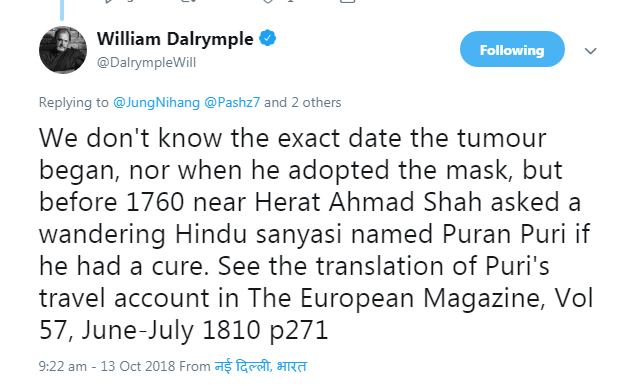
Ahmad Shah Abdali Hid His Face Behind a Bejeweled Mask in 1761? Correcting William Dalrymple
In his fresh book William Dalrymple is making a claim that Ahmad Shah Abdali's face was getting eaten away by disease from "early on in his reign" [while I have read that he suffered from the disease in the last years of his reign]. He further says that his nose was already consumed by the disease when he was fighting at the battle of Panipat (1761) and had replaced it with a diamond-studded substitute. Following is the excerpt from the relevant chapter of his book;
"Few possessors of the Koh-i-Noor have led happy lives, and while Ahmad Shah rarely lost a battle, he was eventually defeated by a foe more intractable than any army. From early on in his reign, his face began to be eaten away by what the Afghan sources call a ‘gangrenous ulcer’, possibly leprosy, syphilis or some form of tumour. Even as he was winning his greatest victory at Panipat, Ahmad Shah’s disease had already consumed his nose, and a diamond-studded substitute was attached in its place". ["Koh-I-Noor: The History of the World's Most Infamous Diamond ", p-67]
It's interesting to note that William Dalrymple has shared two paintings of Ahmad Shah Abdali in his book, dating to circa 1755, which does not show him with any indication of destruction of his face by disease. All the sources say that Ahmad Shah suffered from tumor in the last years of his reign, just few years before his death in 1773. He may have worn face mask at the advanced state of his tumor but William Dalrymple is claiming that he contracted disease "early on in his reign" (circa 1747-1755). The claim that Abdali's face was suppurating, hidden behind a silver mask, on the occasion of the battle of Panipat in 1761, is far-fetched as we have actually eyewitness accounts of that battle (Jafar Shamlu and Kashi Raj), and none reports Abdali in that condition with rotting face and missing nose hidden behind a silver mask.
As for the story of maggots dropping from Abdali's diseased face into his meal, William Dalrymple cites Ganda Singh. But the original inventor of the story is Sir Jadunath Sarkar from whom Ganda Singh copies numerous passages verbatim. And I believe William Dalrymple has also consulted Sir Jadunath Sarkar books. This is evident from the following statement by the latter;
"This tender lamb was to be pounced upon by a fierce Afghan of grandfatherly age whose two ears docked, and nose was rotting from a leprous carbuncle." ["Fall of Mughal Empire", by Jadunath Sarkar Vol-II, p-89]
Sir Jadunath Sarkar is talking about the marriage of Ahmad Shah Abdali with Mughal princess Hazrat Mahal in 1756. He calls Abdali a man of grandfatherly age even though he was just 33 years in 1756 and makes a baseless claim that Abdali's face was rotting in that year.
Alexander Dow (1735 – 1779), an employee of East Indian Company, was contemporary of Ahmad Shah Abdali. When the latter visited his Indian territories in 1767, East India Company collected information about him through their spies and informers. In his book published in 1768, Alexander Dow describes the looks and personality of Ahmad Shah Durrani as follow:-
"This prince is brave and active, but he is now in the decline of life. His person is tall and robust, and inclinable to being fat. His face is remarkably broad, his beard very black, and his complexion moderately fair. His appearance, on the whole, is majestic and expressive of an uncommon dignity and strength of mind. Though he is not so fierce and cruel as Nadir Shah, he supports his authority with no less rigour, and he is by no means less brave than that extraordinary monarch. He, in short, is the: most likely person now in India to restore the ancient power of the empire, should he assume the title of king of Delhi." [The History of Hindostan: Translated from the Persian" by Alexander Dow, 1768, p-348]
Mountstuart Elphinstone who visited Afghanistan in 1808 and wrote an account of kingdom of Kabul in 1815, states that cancer of face first afflicted Ahmad Shah Abdali in 1764 ;
"... but Ahmed Shauh's health now began to decline, and a sensible diminution of his activity is observable from this time forward. His complaint was a cancer in his face; it seems to have first afflicted him severely in 1764, and it continued to do so till his death, which it occasioned." ["An Account of the Kingdom of Caubul, p-556]. This is repeated by H.G.Raverty in 1860.
"His complaint was a cancer in the face, which had afflicted him first in 1764, and at last occasioned his death." ["Selections from the Poetry, of the Afghans", p-291]
Detail from a drawing (circa 1770 AD) showing Ahmad Shah Durrani on horseback during the battle of Panipat (1761). By an anonymous artist in the Faizabad style.
|
William Dalrymple
|
Updates
Portrait of Ahmad Shah Abdali placed in Lahore Museum, circa 1755.
|


.jpg)